

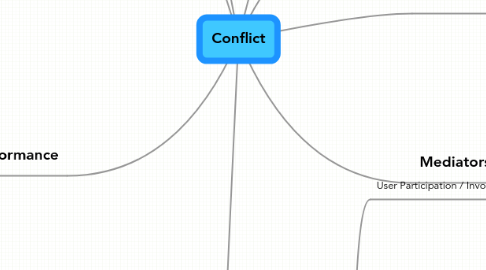
1. Types of Conflict
1.1. Relationship
1.2. Task
1.3. Procedural
2. Team Performance
2.1. 50% of performance accounted for by
2.1.1. Existing levels of conflict
2.1.2. Team member characteristics
2.1.3. Team characteristics
2.2. Conflict Management / Resolution
2.2.1. moderates impact of conflict on performance
2.2.2. effective resolution associated with positive interdependence
2.3. Task Complexity
2.3.1. Conflict during routine tasks not beneficial
2.3.2. Conflict during non-routine tasks beneficial
2.4. Task vs Relationship Conflict
2.4.1. Negative Emotionality associated with poor team performance
2.4.2. Relationship conflict more detrimental than Task conflict
2.4.3. Effective teams rely on cooperative conflict resolution over competitive conflict
2.5. Time
2.5.1. High Performing Team
2.5.1.1. Low level of relationship conflict
2.5.1.2. Low level of task conflict increasing in middle of project and declining at end
2.5.2. Low Performing Team
2.5.2.1. Low conflict until end where conflict peaks
2.6. Structure
2.6.1. Performance enabled by trust & respect
2.6.2. Norms
2.6.2.1. Supporting open discussion of conflict during middle stages of project
2.6.3. Confidence in Professional relationships
2.6.4. Reliance on Cooperative conflict
2.7. Decision Quality
2.7.1. Positively related to positive interdependence
2.8. Goal Setting
2.8.1. Cooperative goals increase organizational effectiveness
3. ISD & Conflict
3.1. User Participation / Involvement
3.1.1. Initial levels of involvement & attitude little influence on participation
3.1.2. User participation impacts future attitude and involvement
3.1.3. Participation strongly associated with influenced
3.1.4. Influence associated with conflict
3.2. Developer & Tester Relationship
3.2.1. Source of Conflict
3.2.1.1. Organisation
3.2.1.1.1. Power & politics
3.2.1.2. Process
3.2.1.2.1. Documentation
3.2.1.2.2. Procedure
3.2.1.2.3. Resource
3.2.1.2.4. Standards
3.2.1.3. People
3.2.1.3.1. Attitude
3.2.1.3.2. View
3.2.1.3.3. Focus
3.2.1.3.4. Knowledge
3.2.1.4. Communication
3.2.1.4.1. Left out of loop
3.2.1.4.2. Misunderstanding of responsibilities
3.2.1.4.3. Last minute
3.2.1.4.4. Not communicating changes
3.2.1.4.5. Lack of feedback
3.2.2. Resolution
3.2.2.1. Structure for Success
3.2.2.1.1. Co-location of staff
3.2.2.1.2. Remove Developer tester divide
3.2.2.1.3. Integrate staff e.g. reduce 'intellectual distance'
3.2.2.1.4. Management signal importance of issues
3.2.2.1.5. Careful performance metrics to incentivize cooperation
3.2.2.2. People
3.2.2.2.1. Conflict Resolution Training
3.2.2.2.2. Frequent contact between staff
3.2.2.2.3. Structured work activities acquaint actors with each others work
3.2.2.3. Process
3.2.2.3.1. Time management
3.2.2.3.2. Ensure common goals
3.3. Stakeholder
3.3.1. Frame incompatibility
3.3.1.1. Inability to answer questions in terms of others world view
3.3.1.2. Language differences
3.3.2. Incompatible / specialized knowledge
3.3.3. Power relationships
3.3.3.1. certain groups given superiority resulting in other groups being ignored
3.4. ISD models
3.4.1. Waterfall model
3.4.1.1. Manages conflict via suppression
3.4.1.1.1. Power relationship between developer & user
3.4.1.1.2. Rigid & structured interaction
3.4.2. Iterative Incremental model
3.4.2.1. Manages conflict via iteration
3.4.2.1.1. User & developer have more balanced power relationship
3.4.2.1.2. User & developer have shared goals encouraging cooperative behaviour
3.4.3. Component based Development model
3.4.3.1. Manages conflict via contract negotiation
4. Behavioral Styles
4.1. Asserting
4.1.1. Win/lose where one side must dominate
4.2. Accommodating
4.2.1. Win/lose where one side must yield to other
4.3. Compromising
4.3.1. Multiple Win/lose where sides take turns to yield to each other
4.4. Problem solving
4.4.1. opportunity to incorporate all views into Win-win solution. Aim to maximize all parties satisfaction
4.5. Avoiding
4.5.1. Conflict is not entered and indifference is shown towards the situation
5. What is Conflict?
5.1. Interdependence
5.1.1. Positive
5.1.2. Negative
5.2. Disagreement
5.3. Interference
5.4. Negative Emotion
6. Mediators of Conflict
6.1. Perceptual Frame
6.1.1. Gain vs Loss Framing
6.2. Personal Characteristics
6.2.1. No significant effect
6.3. Team Characteristics
6.3.1. No significant effect
6.4. Structural Characteristics
6.4.1. Norms encouraging/accepting conflict
6.4.2. Scarcity of Resources
6.5. Power, Trust
6.6. Communication
6.7. Task Interdependence
6.8. Task Importance
7. Team Satisfaction
7.1. All types of conflict negatively related
7.2. Negative emotion negatively related
7.3. Relationship conflicts have more negative impact that task conflict
7.4. Role ambiguity has greater impact than role conflict
8. Behavioral Strategies
8.1. Integrative component
8.1.1. Extent that total outcome for both parties is maximised
8.1.2. positively related to positive interdependence
8.1.3. negatively related to relationship conflict
8.2. Distributive component
8.2.1. Extent that an unequal outcome is maximised
8.2.2. negatively related to positive interdependence