

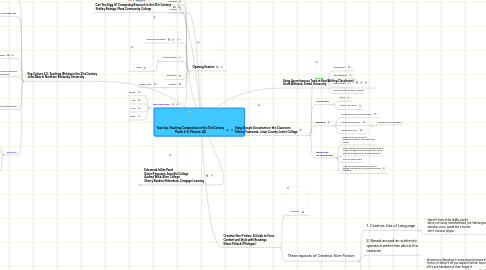
1. Opening Session
1.1. Assessment
1.2. Grammar
1.3. Grading
1.4. Motivation/Perception
1.5. Critical Thinking
1.5.1. Image
1.6. Technology
1.7. Research
1.7.1. Google Voice
1.8. Word Cloud Image
1.8.1. Wordle
1.8.2. Jing
1.8.3. Flickr
1.8.4. Picnik
2. Enhanced InSite Panel Daniel Ferguson, Amarillo College Audrey Wick, Blinn College Sherry Rankins-Robertson, Cengage Learning
2.1. TOOLS
2.1.1. GradeMark
2.1.1.1. Rubrics
2.1.1.2. easy to mark and make own repeated comments
2.1.1.3. keep track of all documents
2.1.1.4. connected w/TurnItIn
2.1.1.5. identify patterns of error
2.1.2. Peer Mark
2.1.3. NetTutor
2.1.4. eBook
2.1.4.1. highlight
2.1.4.2. comment
2.1.5. InfoTrac
2.2. REASONS
2.2.1. Easier/Time Saving
2.2.2. Paperless/Green class
2.2.3. better peer reviews
2.2.4. everything housed in one area
2.2.4.1. Learning Management System (LMS)
2.2.4.2. Portfolio
2.2.4.3. Exercises
3. Pop Culture 2.0: Teaching Writing in the 21st Century John Alberti, Northern Kentucky University
3.1. Started with Cultural Markers Quizzes
3.1.1. Pew's Millennial Quiz
3.2. Pop Culture in the Digital Age
3.2.1. Web-based
3.2.1.1. Accessible
3.2.1.2. Non-hierarchical
3.2.2. Digital
3.2.2.1. Words, pictures, and sound are all information
3.2.3. Radically Interactive
3.3. Wikipedia
3.3.1. Hopes
3.3.1.1. links to resources/bibliography mining
3.3.2. Fears
3.3.2.1. incorrect info
3.3.2.2. make everyone an expert
3.4. A New Old Environment for Writing Instruction
3.4.1. A radically process world
3.4.2. Knowledge is fluid
3.4.3. Authority is contextual
3.4.4. From edit, then publish, to publish, then edit.
3.5. Return to Writing, Writing Means:
3.5.1. Lessons for the Writing Class
3.5.1.1. focus on what endures: the rhetorical context
3.5.1.2. importance of context & purpose
3.5.1.3. Game theory
3.5.2. Writing Means
3.5.2.1. social status
3.5.2.2. fun
3.5.2.3. self expression
3.6. Resources
3.6.1. Pew 2007 Teen & Media Report
3.6.1.1. 39% share their artistic creations online
3.6.1.2. 33% works on webpages or blogs for others
3.6.1.3. 28% have their own blogs
3.6.1.4. 26% remix content
3.6.2. The Democratization of Online Social Networks (Pew, 2009)
3.6.2.1. 79% of adults use the internet
3.6.2.2. 46% adults use social networking
3.6.2.3. 65% of teens use social networking
4. Can You Digg It? Composing Research in the 21st Century Shelley Rodrigo, Mesa Community College
5. New node
6. Using Asynchronous Tools in Your Writing Class[room] Scott Warnock, Drexel University
7. Using Google Documents in the Classroom Tammy Townsend, Jones County Junior College
7.1. Benefits
7.1.1. Collaboration
7.1.2. Web Publishing
7.1.3. Web Storage
7.1.4. Easy Interaction w/other Programs
7.2. Disadvantages
7.2.1. Space
7.2.2. Limited, "it's a mule"
7.3. Resources
7.3.1. Google Docs in Plain English Video
7.3.2. Google For Educators
7.3.2.1. Google Docs for Educators
7.3.3. Google at MCCCD
7.4. Tammy's Tips: You Need to Know
7.4.1. When you invite, be sure to distinguish between "edit" and "view" modes
7.4.2. When editing, if you notice it is getting slow, it freezes up when writing at same time...pause and take a breath (up to 10 people at once)
7.4.3. You can't mess it up!!!
7.4.4. Make sure your students have a way of putting class they are in (document naming strategy)
8. Creative Non-Fiction: A Guide to Form, Content and Style with Readings. Eileen Pollack (Michigan)
8.1. New node
8.2. Three aspects of Creative Non-Fiction
8.2.1. 1. Creative Use of Language
8.2.1.1. -doesn't have to be wildly poetic -we're not using manufactured, pre-fab language -develop voice, speak like a human -don't overuse jargon
8.2.2. 2. Based around an authentic question writer has about the material
8.2.3. 3. Relies on Creative Use of form/structure
8.2.3.1. -structure is liberating in some ways because there's not chaos -limits is it doesn't let you explore certain topics -if it's just handed out, then forget it -we want forms that are organic & have a life of their own -correspond to the world we experience -Narratives are easy to structure, but some people don't understand how they are relevant to their writing learning. -Even with personal experience, what is it about this writing that makes it important? -There has to be something about that story that you don't get. -Themes will emerge from that question; try to answer that question through the writing of the narrative