
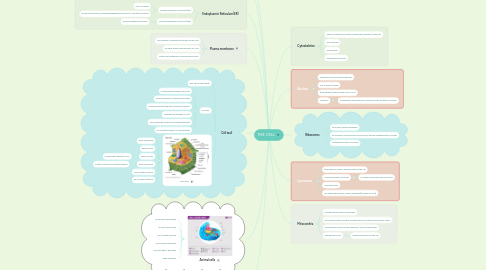
THE CELL

Plan your life and the next important steps and goals to proceed with a happy life

1. receives,stores,concetrate,modifies,finishes and sorts proteins
2. Golgi body
2.1. tough, rigid, thick non-living structure
2.2. consist of a stack of flattened membranous sacs known as cisterinae
3. Endoplasmic Reticulum(ER)
3.1. Rough endoplasmic reticulum(RER)
3.1.1. next to nucleus
3.1.2. synthesizing protein,modifying,packaging and transport of secretory proteins
3.2. Smooth endoplasmic reticulum(SER)
3.2.1. diverse metabolics activities
4. Plasma membrane
4.1. encloses the cytoplasm/protoplasm of the cells
4.2. provides shape and protection for cells
4.3. protein are embedded in phospholipid bilayer
5. Cell wall
5.1. give very difine shapes
5.2. Function:
5.2.1. maintaining the shape of the cells
5.2.2. semi-permeable or selective permeable
5.2.3. providing strength and give mechanical support
5.2.4. maintains the turgidity of cells
5.2.5. allow exchange substance during homeostasis
5.2.6. an important reserve of carbohydrates
5.3. Plant cells
5.3.1. have fixed shape
5.3.2. have cell wall
5.3.3. have vacuoles
5.3.3.1. maintaining turgidity of cells
5.3.4. have chloroplast
5.3.4.1. contain chloropyll for photosynthesis
5.3.5. food storage at starch
5.3.6. do not have centrioles
6. Animal cells
6.1. do not have fixed shape
6.2. do not have cell wall
6.3. do not have vacuoles
6.4. do not have chloroplast
6.5. food storage at glycogen
6.6. have centrioles
7. Chloroplast
7.1. biconvex disc shape
7.2. have their own DNA, RNA and ribosomes
7.3. enclosed by two memmbranes separated by intermembrene space
8. Cytoskeleton
8.1. made of filamentous protein networks and skeleton of the cells
8.2. microfilament
8.3. microtubules
8.4. intermediate filaments
9. Nucleus
9.1. largest and most prominent organelle
9.2. oval or sperical shape
9.3. store genetic material in the form of DNA
9.4. Nucleolus
9.4.1. to synthesize ribosomal RNA subunits for the synthesis of protein
10. Ribosomes
10.1. small,solid, spherical granules
10.2. an assembly of two ribosomal RNA(rRNA) that are synthesizedd in nucleus
10.3. synthesized protein molecules
11. Lysosomes
11.1. dark spherical bodies, recyling center of the cell
11.2. contains hydrolytic enzymes
11.2.1. to digest macromolecules in the cells
11.3. recycling centre
11.4. also digest the remains of dead organelle(autolysis process)
12. Mitocondria
12.1. bounded by two layerof membrane
12.2. the cristae partially divide by mitochondrial fluid called mitochondrial matrix
12.3. mitochondrial matrix contains enzymes, DNA and ribosomes
12.4. powerhouse of cell
12.4.1. energy production for the cell