Раскройте весь потенциал своих проектов.
Попробуйте MeisterTask бесплатно.
Нет аккаунта?
Бесплатно
Просматривать
Избранные Карты
Категории
Управление проектом
Бизнес и цели
Человеческие ресурсы
Мозговой штурм и анализ
Маркетинг и контент
Образование и заметки
Развлечения
Жизнь
Технологии
Дизайн
Резюме
Другое
Язык
English
Deutsch
Français
Español
Português
Nederlands
Dansk
Русский
日本語
Italiano
简体中文
한국어
Другое
Показать всю карту
Копировать/изменить
Копировать
Phonetics
Другое
NB
Nathaly Brassfield
Отслеживать
Начать.
Это бесплатно
Войти через Google
или
регистрация
c помощью Вашего email-адреса
Похожие Интеллект-Карты
План Интеллект-Карты
Phonetics
создатель
Nathaly Brassfield
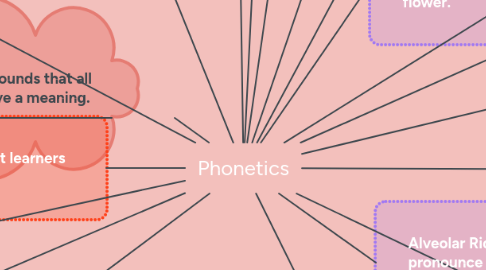
1. Is the study of the sounds that all languages use to give a meaning.
1.1. To represent the sound, the letter must be inside this format. /a/.
2. The importance is that learners can comunicate.
3. In English diferent letters can represent diferent sounds.
4. English sounds 25 consonants, 11 vowel sounds, and 3 diphthongs.
5. Some letters have no sound.
6. A sound cn be represented by a combination of letters.
7. Phonetics Division
8. Acoustic Phonetic: vocal properties of the sound.
9. Auditory Phonetics: studies how the sounds are perceived by the ear.
10. Articulatory Phonetics: study of the vocal track.
10.1. Auditory Phonetic: the sound perceived by the air.
11. The Vocal Track Parts: lips, teeth, tongue, alveolar ridge, nasal cavity, hard palate, oral cavity, velum, nasal cavity, pharyx, espiglottis and esophagus, larynx and vocal cords.
12. Teeth: are used to pronounce words such as thank, this and both.
13. Lips: are used to pronounce words such as: mom and flower.
14. Alveolar Ridge: is used to pronounce words such as tomato and darling.
15. Hard Palate: it is the roof of the mouth. (sounds like:young, shine and ear)
16. The Velum: this is sometimes refering to the soft palate. Sound such as: cat and goat.
17. The uvula: it is a movable part at the back of the mouth 's roof (arabic language)
18. The Glottis: is it back in the throat.
19. Vocal Cords: thry oronounce the major varieties of sounds. Sounds can be voiced or voiceless sound.
20. Tongue: words like zipper, lord and mother.
Начать. бесплатно!
Связать с Google
или
Регистрация