


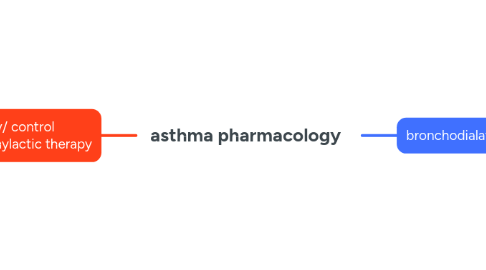
1. Anti-inflammatory/ control medication, prophylactic therapy
1.1. Glucocorticoids
1.1.1. Drugs
1.1.1.1. Inhaled
1.1.1.1.1. beclomethasone
1.1.1.1.2. budesonide
1.1.1.1.3. fluticasone
1.1.1.2. oral
1.1.1.2.1. prednisone
1.1.1.3. injection
1.1.1.3.1. hydrocortisone
1.1.1.3.2. methylprednisolone
1.1.2. Uses
1.1.2.1. first line severe asthma therapy
1.1.2.2. asthma patients no improved by bronchodialtors
1.1.3. MOA
1.1.3.1. inhibition of phospholipase-A2
1.1.3.2. mast cell stabilization
1.1.3.3. up-regulation of airways B2 receptors
1.1.4. ADRs
1.1.4.1. inhaled
1.1.4.1.1. oropharyngeal candidiasis
1.1.4.1.2. hoarseness of voice
1.1.4.2. systemic
1.1.4.2.1. hypertension
1.1.4.2.2. hyperglycemia
1.1.4.2.3. immune suppression
1.1.4.2.4. cushings syndrome
1.1.4.2.5. adrenal suppression
1.2. Leukotriene modifiers
1.2.1. drugs
1.2.1.1. lipoxygenase inhibitors
1.2.1.1.1. Zileuton
1.2.1.2. leukotriene receptor antagonists
1.2.1.2.1. Monteluast
1.2.1.2.2. Zafirlukast
1.2.2. MOA
1.2.2.1. bronchodilation
1.2.2.2. anti-inflammatory
1.2.3. Uses
1.2.3.1. prophylaxis of asthma in children
1.2.3.2. aspirin-induced asthma
1.2.4. ADRs
1.2.4.1. dyspepsia
1.2.4.2. macular rash
1.2.4.3. liver dysfunction
1.2.4.4. churg-strauss syndrome
1.3. Mast cell stabilizers
1.3.1. drugs
1.3.1.1. Cromolyn
1.3.1.2. Nedocromil
1.3.2. MOA: prevent mast cells from releasing inflammatory mediators
1.3.3. Uses
1.3.3.1. Allergic rhino-conjunctivitis (hay fever)
1.3.3.2. food allergy
1.3.3.3. systemic mastocytosis
1.3.4. ADRs
1.3.4.1. cough and irritation of airways
1.4. igE antibody
1.4.1. drugs
1.4.1.1. Omalizumab
1.4.2. MOA: bind to human igE on mast cells and basophile= decrease release of inflammatory mediators
1.4.3. Uses: severe asthma unresponsive to conventional treatment
2. greater first pass metabolism= less systemic effects
3. prevented by: spacer device, saline gargle
4. bronchodialators/quick relief
4.1. short acting B2-agonist
4.1.1. durgs
4.1.1.1. Salbutamol
4.1.1.2. Terbutaline
4.1.2. use: acute episodes of bronchospasm
4.1.3. MOA: Stimulate adenylyl cyclase which increases cAMP in smooth muscle and produce bronchodilation
4.1.4. ADRs
4.1.4.1. Muscle tremor
4.1.4.2. Tachycardia and arrythmias
4.1.4.3. hypokalemia
4.1.4.4. Tolerance
4.1.5. Contraindications
4.1.5.1. B receptor antagonists
4.2. Anti-muscarinics
4.2.1. drugs
4.2.1.1. Ipratropium (short acting)
4.2.1.2. Tiotropium (long acting)
4.2.2. Uses
4.2.2.1. adjunct to B2 agonist and steroids in asthma
4.2.2.2. COPD
4.2.2.3. Bronchospasm caused by B2 blocker
4.2.3. MOA: Inhibit acetylcholine at airways muscarinic receptors which prevents bronchoconstriction
4.2.4. ADRs
4.2.4.1. Dry mouth
4.2.4.2. Constipation
4.2.4.3. urine retention
4.2.4.4. blurred vision
4.2.4.5. tachycardia
4.2.5. cautions
4.2.5.1. glaucoma
4.2.5.2. benign prostatic enlargement
4.3. Methylxanthines
4.3.1. drugs
4.3.1.1. Theophylline (oral)
4.3.1.2. Aminophylline (IV)
4.3.2. Uses alongside steriods
4.3.2.1. Asthma not responding to B2 agonist
4.3.2.2. Acute severe asthma (Aminophylline)
4.3.2.3. COPD
4.3.3. MOA: Inhibit phosphodiesterase results in increased cAMP and bronchodilation
4.3.4. ADRs
4.3.4.1. Tachycardia and arrythmia
4.3.4.2. tremors
4.3.4.3. palpitaions
4.3.4.4. palpitations
4.3.4.5. nervousness
4.3.5. Overdose
4.3.5.1. Symptoms
4.3.5.1.1. nausea and vomiting
4.3.5.1.2. hypotension
4.3.5.1.3. arrhythmia
4.3.5.1.4. seizures
4.3.5.2. Treatment
4.3.5.2.1. Beta blockers
4.3.6. PK
4.3.6.1. Narrow therapeutic window
4.3.6.2. metabolized by CYP enzyme
4.3.6.3. age dependent metabolism
4.3.7. metabolism and clearance
4.3.7.1. increased by
4.3.7.1.1. CYP induction
4.3.7.1.2. smoking
4.3.7.1.3. childhood
4.3.7.2. decreased by
4.3.7.2.1. CYP inhibition
4.3.7.2.2. Liver disease
4.3.7.2.3. CHF
4.3.7.2.4. old age