

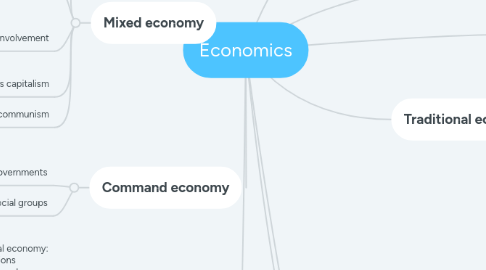
1. Command economy
1.1. Central governments
1.1.1. Economoc decisions
1.2. Communists social groups
1.2.1. Korea and Cuba
2. Mixed economy
2.1. Command and market forces
2.2. Socialist approach
2.2.1. Government
2.2.1.1. Basic productive resources
2.2.2. Privately owned
2.2.2.1. Rest of the businesses
2.3. Large government involvement
2.3.1. More say in the economy
2.3.1.1. Everyone to be provided for
2.3.2. Less say in capitalism
2.4. Not effecient as capitalism
2.5. Mixture of capitalism and communism
2.5.1. Freedom of Market forces
2.5.1.1. Government intervention
2.5.1.1.1. Welfare side of society
3. Micro economics
3.1. National economy: Operations Components
3.2. Markets
3.2.1. Contribute to pillass of food security
3.2.1.1. Availability Access Stability
3.2.2. Supply shortfall
3.2.3. Supply
3.2.4. Demand
3.2.4.1. Primary and Derived
3.2.5. Elasticity
3.2.6. Market distortions
3.3. Individuals
3.4. Firms
3.5. Terms of Trade
3.6. Parity Pricing
3.6.1. Measures of how much is exported
3.6.2. Compare commodity
3.6.3. Quantify the incentives to trade
3.7. Investments
3.8. Commodity and food prices
3.9. Financial speculation
3.9.1. Instigating food price rises
3.9.2. Adding to pressure of inflation
3.9.2.1. Affecting food stability
3.9.2.2. Affect real prices
3.10. Corporate control
3.10.1. Transnational corporations
3.10.1.1. Agricultural business sector
3.10.1.1.1. Horizontal intergration Vertical intergration strategies
4. Exchange rates
5. Change and growth
6. Captalist values
7. Traditional economy
7.1. Status quo
7.2. Regions relying
7.2.1. Subsitence farming
7.3. Customs and traditions
8. Market economy
8.1. Market
8.1.1. Supply and demand
8.2. Most effective
9. Macro economics
9.1. Economy growth
9.2. Business cycle
9.3. Inflation
9.4. Monetary and regulation policies
9.5. Economic development
9.6. Balance of payment
9.6.1. Record of all monetary transaction
9.6.2. Current Capital Reserve account
9.7. Current account
9.7.1. Tracks all monies
9.7.2. Made up of three accounts
9.7.3. Trade deficit
9.7.3.1. Net outflow of monies
9.8. Balance of trade Net investment income Other transfers
9.9. Capital account
9.9.1. Tracks country's assets
9.10. Foreign direct investment Portfolio investment Other investment
9.11. Reserve account
9.11.1. Official settlement account
9.11.2. Net inflow of funds
9.11.2.1. Increases country's assets
9.11.2.2. Places pressure on domestic currency
9.11.2.2.1. Expressed through inflation Exachnge rates Strong local currecy