
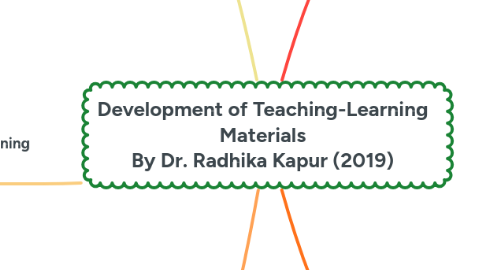
Development of Teaching-Learning Materials By Dr. Radhika Kapur (2019)

Development of Teaching-Learning Materials By Dr. Radhika Kapur (2019)

1. Objectives of TLMs
1.1. Motivate learners.
1.2. Develop knowledge and skills among teachers.
1.3. Help in longer retention of information.
1.4. Facilite holistic learning.
1.5. Asist in arganizing classroom teaching.
1.6. Promote effective communication.
1.7. Facilitate change in attitudes.
1.8. Enable practical applications.
1.9. Make learning pleasurable.
1.10. Facilite concept training.
2. Importance of teaching-learning materials (TLMs)
2.1. Support educators in presenting educational content.
2.2. Help students understand academic concepts.
2.3. Promote students motivation.
2.4. Develop creativity.
2.5. Evoke prior knowledge
2.6. Improve logical thinking, reasoning, and commucation skills.
2.7. Contribute to the dcevelopment of various skils, values, and attitudes ammong students.
3. Recommendations
3.1. Ensuring needs and requirements.
3.2. Prepare a framework for review and renewal.
3.3. Generate awareness.
3.3.1. Methods and approaches.
3.4. Teaching materials should be developed by teachers.
3.5. Formulate measures and plans.
3.6. Develop an equitable distribution mechanism.
3.6.1. Provide for maintenance and replacement.
3.7. Use of the teaching and learning assessment calendar.
3.7.1. Implementation of units of study
3.7.1.1. Share learning objectives and outcomes.
3.8. Educators should act as leaders, guides and advisors to learners.
4. Types of Teaching-Learning Materials
4.1. Audio and video
4.1.1. Helps improve comprehension and retention and develop skills
4.2. Textbooks
4.2.1. It contains systematically organized information on one or more subjects.
4.3. Graphics
4.3.1. They simplify information and encourage active learning
4.4. Posters
4.4.1. To represent concepts or ideas in a creative manner.
4.5. Models
4.5.1. Imitation of something real. For example, the globe imitates the Earth.
4.6. Overhead Projector
4.6.1. Display visual material with enlarged projection.
4.7. Power Point Slides
4.7.1. You can make presentations that include images, text and animations.
4.8. Computers
4.8.1. Essential for understanding academic content.
4.9. Reports
4.9.1. Deepen understanding of concepts.
5. Designing and Development of Teaching-Learning Materials
5.1. Collection
5.1.1. Materials: bamboo, plastic, rubber, paper, paints, etc.
5.1.2. Considerations: goals and objectives, student participation, safety when using tools.
5.1.3. Sources: neighborhoods, homes, natural environments.
5.2. Preparation
5.2.1. Factors to consider: grade levels, subjects and concepts, academic goals.
5.2.2. Types of TLMs: posters, charts, etc.
5.2.3. Guidance: instructions to create simple TLMs, training programms, workshops.
5.3. Maintenance
5.3.1. Use of skills, capabilities, financial resources and time.
5.3.2. You must have space.
5.3.3. Organize and maintain.
5.3.4. Check and make repairs immediately to the master.
5.3.5. Maintenance must be adequate and well planned.