

1. Creative Writing
1.1. What is meaningful to me?
1.1.1. Writing allows for self-expression in a way that speech sometimes doesn't quite do.
1.1.2. Storytelling connects people across time and place.
1.2. Who else does it positively impact?
1.2.1. Readers who find pieces of themselves in the stories I share.
1.2.2. Future generations who might use writing as a way to understand their own heritage and background.
1.3. Why is it important to me and others?
1.3.1. Writing is a form of memory-keeping.
1.3.1.1. Lets you explore themes like belonging, loss and reconnection even if you as the writer don't have all the answers yet.
2. Food/Cooking
2.1. What is meaningful to me?
2.1.1. Certain dishes bring a sense of comfort and nostalgia, even when I'm away from home.
2.1.1.1. The process of cooking is just as meaningful as the final dish.
2.1.1.2. The connection, memory and tradition.
2.1.1.2.1. A bridge between cultures.
2.2. Who else does it positively impact?
2.2.1. Family, cooking together strengthens our bonds and allows knowledge to be passed down.
2.2.2. Friends, because sharing meals is a love language too.
2.2.3. The wider community, since food brings people together.
2.3. Why is it important to me and others?
2.3.1. It's a form of cultural preservation that doesn't require deep knowledge, just experience and going in.
2.3.1.1. Cooking is a universal language.
3. Film
3.1. What was this influenced/inspired by? (Making an audience feel something)
3.1.1. Stories of belonging and identity often resonate deeply with me.
3.2. What is meaningful to me?
3.2.1. The way certain films reflect personal experiences of growing up between cultures.
3.2.1.1. The idea that media plays a role in shaping a person's perception of life.
3.2.1.2. Using storytelling as a way to process and understant identity.
3.3. Who else does it positively impact?
3.3.1. People who feel seen through representation in media.
3.3.2. Future creators who want to tell diverse stories.
3.4. Why is it important to me and others?
3.4.1. Challenges stereotypes through diverse storytelling.
4. India
4.1. How has being not very religious in a religious culture shaped my mindset?
4.1.1. Made me more open to different belief systems and perspectives.
4.1.2. Sometimes, it makes me feel disconnected from certain traditions and conversations.
4.1.2.1. Can cultural identity exist separately from religion?
4.2. What is meaningful to me?
4.2.1. The ability to form my own opinions about beliefs.
4.2.2. Finding ways to stay connected to cultural traditions without religious ties.
4.2.2.1. Understanding that faith, culture and identity are separate but intertwined.
4.3. Who else does it positively impact?
4.3.1. People who also feel caught between personal beliefs and cultural norms.
4.3.2. Encourages open-minded discussions about faith and identity.
4.4. Why is it important to me and others?
4.4.1. It allows for personal growth and evolving beliefs.
5. Family
5.1. How have they shaped me to be who I am?
5.1.1. Their values and habits have influenced my personality and decision-making.
5.1.1.1. They've set expectations that have shaped my ambitions and self-discipline.
5.1.1.1.1. Academic
5.1.1.1.2. Personal
5.1.1.1.3. Moral
5.1.2. I've inherited certain ways of thinking.
5.1.2.1. My approach to problem-solving or how I handle stress.
5.1.2.1.1. They've shaped my perception of what and who a "good" person is.
5.1.2.1.2. They're experiences as migrants shape how they see the world and how they expect me to see it.
5.2. What is meaningful to me?
5.2.1. Small moments, like family meals or inside jokes, hold more value to me than grand gestures.
5.2.2. Traditions that I once took for granted now feel more important as a I grow older.
5.2.2.1. I sometimes feel a gap between my family's experiences and mine, this affects how I relate to them.
5.3. Who else does it positively impact?
5.3.1. My family, as I make an effort to understand and appreciate their past.
5.3.1.1. Especially, my younger brother, unlike me, he has someone to guide him through any concerns he may have. I want to be that for him.
5.3.2. My future self, since what I choose to embrace now could shape how I pass down traditions later.
5.3.3. Friends from similar backgrounds, as we share and validate each other's experiences.
5.4. Why is it important to me and others?
5.4.1. Understanding my family's journey might help me understand myself better.
5.4.1.1. It creates a sense of belonging.
5.4.1.1.1. Makes me wonder thouhg: can you truly belong to more than one culture?
5.4.1.2. This reflection could help others who feel disconnected from their heritage.
5.4.1.2.1. Could even help those who do feel connected but are unsure about how to give that connection to their kids/people who struggle with that.
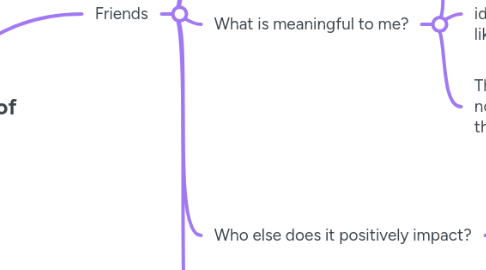
6. Friends
6.1. What kind of friends do I want to take into university/later stages of my life?
6.1.1. People who respect me and my past.
6.1.1.1. Past meaning that it encompasses everything about me including cultural differences.
6.1.2. Those who value conversations and mindsets around personal growth and belonging to yourself first before others.
6.1.2.1. Friends who support each other and self-discovery.
6.2. Who/what kind of people will naturally grow apart? How is this a reflection of me?
6.2.1. Those who don't make an effort to understand my background or experiences.
6.2.2. People whose values or goals no longer align with mine.
6.2.2.1. This reflects how I'm evolving maybe I'm becoming more aware of what truly matters to me.
6.3. What is meaningful to me?
6.3.1. Friendships that feel like home, regardless of where we come from.
6.3.2. Friends who help me explore my identity rather than make me feel like I have to choose one side.
6.3.3. The idea that experiences (even if not cultural) create stronger bonds than shared backgrounds.
6.4. Who else does it positively impact?
6.4.1. People who also struggle with feeling "in between" two worlds.
6.4.2. Future connections I make, as learning to navigate cultural identity helps build empathy.
6.4.2.1. Anyone who values friendships that go beyond surface-level similarities.
6.5. Why is it important to me and others?
6.5.1. Friendships shape our sense of belonging, which is espeically important when navigating identity.
6.5.1.1. it challenges the idea that you need to surround yourself only with people "like you" to feel understood.
6.5.1.2. The right friendships can help reinforce cultural appreciation rather than cultural loss.
7. Academics
7.1. How can I be successful and proud?
7.1.1. Success isn't just about grades, it about feeling fulfilled and challenged.
7.1.1.1. Can I pursue a career that respects both personal ambitions and expectations?
7.1.2. Understanding my background could give me a unique perspective in my field.
7.2. How to prove my worth?
7.2.1. Recognising that my experiences and background add value beyong just academic achievement.
7.2.1.1. Finding ways to integrate personal interests into my achievements.
7.3. What is meaningful to me?
7.3.1. Learning about subjects that help me understand society and identity better.
7.3.1.1. Exploring how personal background influences academic interests, does my upbringing affect what I'm drawn to?
7.3.1.2. The idea that education can be a tool to reconnect with cultural knowledge.
7.4. Who else does it positively impact?
7.4.1. People in my field, if i Can bring a unique perspective shaped by my identity.
7.4.2. My family, who might see my passion as proof of success.
7.5. Why is it important to me and others?
7.5.1. Education shapes identity and I want to explore how mine has shaped mine.
8. Appearance
8.1. How/when do I feel like my best self?
8.1.1. When I wear clothes that reflect my personal style.
8.1.2. When I feel confident in my identity, regardless of how others percieve me.
8.1.3. When I embrace elements of my heritage rather than shy away from them.
8.2. What is meaningful to me?
8.2.1. Self-expression through language and mannerisms.
8.2.1.1. The feeling of confidence that comes from embracing all parts of myself.
8.3. Who else does it positively impact?
8.3.1. People who struggle with societal beauty standard.
8.3.1.1. Younger generations who need role models that embrace both individuality and heritage.
8.4. Why is it important to me and others?
8.4.1. Confidence in identity affects all aspects of life, from social relationships to career ambitions.