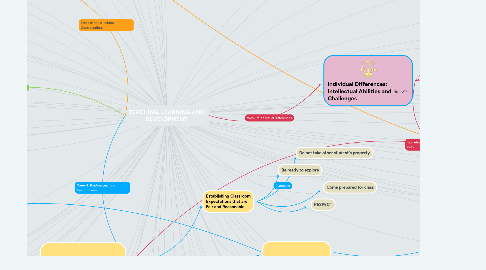
7. Explementary Learning Environment: academic success is dependent on the learning environment creating exemplary learning environments requires good planning and good classroom management the goal of classroom management is to provide all students with optimum opportunities for learning exemplary learning environments especially important for students with exceptionalities
8. Teacher Effectiveness
9. Language
10. Creativity
11. Problem Solving
12. Memory
13. Operant Conditioning: presentation of different stimuli and was able to conclude that behaviour is shaped by its consequence
14. Cognitive Approach: A cognitive procedure used to learn/understand new material. It uses mental approach to thought
15. Classical Conditioning: a learning process that occurs when two stimuli are repeatedly paired; a response that is at first elicited by the second stimulus is eventually elicited by the first stimulus alone.
16. Behaviourist Approach: a learning theory that only focuses on objectively observable behaviours and discounts any independent activities of the mind.
17. Scaffolding: Providing just enough support to prompt learning
18. Zone of Proximal Development: Tasks that a student cannot complete independently but can complete when given assistance
19. Disequilibrium: A state of imbalance between what a child understands and what he or she does not
20. Equilibrium: a state of balance in a child's schemas they are capable of explaining what it can perceive around him or her.
21. Vygotsky
22. Dialogue and Instructional Conversations
23. Adaptation: Is an innate drive to adjust to one's surrounding environment
24. Assimilaton: the process in which a child takes information from the environment into their minds
25. Piaget
26. Multiple representations of Content: e.g. Visual, Auditory, and Kinesthetic
27. Complex and Diverse Work Environments
28. Real-World Applications
29. Teacher and Peer Learning
30. Group/Collaborative Work
31. Inquiry-Based Learning
32. Applications of Constructivism in the Classroom
33. Constructivist Views of Learning: -Learners actively constructed and seek their own meaning -Social negotiating is important to knowledge construction /learning • Learning includes developing skills to solve problems, think critically, answer questions, accept multiple views • Self-determination is needed to further knowledge development
34. Teacher Centred Approach to Teaching: The teacher determines the content, provides direction, and sets academic and social tone
35. Student-Centred Approach to Teaching: The teacher adopts a constructivist perspective and acknowledges that students actively construct their own understandings
36. Principles of Development: Orderly progression/gradual process • Periods of rapid and slow growth • Quantitative and qualitative changes • Individuals develop at different rates • Genetics set developmental potential • Environment determines potential realized
37. Most Likely to Succeed
38. Newcomers to Canada
39. Religions Practised
40. Single-parent families
41. Same-sex families
42. Honour all Celebrations
43. Indigenous Students
44. Languages Spoken
45. Increasing Diversity
46. Inclusion: "Children are different All children can learn Different abilities, ethnic groups, size, age, background, gender. Change the system to fit the child"
47. Stereotype Threat: is the fear, existing either in your own eyes or in the eyes of others, that your behaviour will confirm an existing negative stereotype about your identity group (p.252)
48. Socio-economic status: Indicator of social class based on education, occupation, and income. One of the most important aspects to consider to avoid bias or stereotypes
49. Socio-Cultural Considerations
50. Considering Child and Adolescent Development
51. Creating Positive Learning Environments
52. RESPECT
53. Be ready to explore
54. Come prepared for class
55. Do not take other student's property
56. Absolute Quiet
57. Constant Criticism
58. Teacher is yelling over the class
59. Rigid Lesson planning
60. Chaotic good
61. Wrong kind of chaos
62. Teachers who are merely there for the paychecks
63. Diverse methods of teaching E.g. visual, auditory
64. Constructive feedback
65. Passionate Teachers
66. Flexible Lessons
67. Students are engaged
68. Establishing Classroom Expectations that are Fair and Reasonable
69. Establishing Student Learning Profiles to ensure all their needs will be met
70. Flexibility
71. Understand and Use feedback
72. Various Media
73. Alternative Assignments
74. Educational Assistants
75. IEP: Individualized Education Programs
76. Laptops and Speech Boards
77. Books with LARGE text
78. Accessibility Ramps
79. Cognitive Access to Curiculum: Understanding assignments, planning and executing approaches to tasks
80. Keyboards
81. Audio tapes
82. Physical Access to Curriculum: Sensory and Motor
83. Low-Incidence Exceptionalities: Moderate and Severe Disabilities =Autism =hearing and visual impairments =serious health impairments, =multiple disabilities
88. Why is it Important to understand intelligence? To understand and help students develop their cognitive abilities
89. Carroll's Hierarchical Model of Intelligence: intelligence operates in hierarchical fashion. The top level is overarching general intellectual ability. The second level carry out different cognitive tasks. The bottom level has specific information-processing actions (p.193)
90. Gardner's Multiple Intellgiences Theory: that contends that there are eight separate intelligence structures and that every individual has varying levels of each intelligence (p.194)
91. Negative Classroom Environment
92. Positive Classroom Environment
93. Full Inclusion:
94. Inclusion
95. Multiple Intelligences Self-Assessment
96. Sternberg's Triarchic Theory Triangle: theory that emphasizes a series of interdependent intelligence processes that people use to learn and solve problems (p.196)
97. Special Education: Schooling that is constructed and delivered to suit the needs of students with exceptionalities (p.200)
98. Individual Differences: Intellectual Abilities and Challenges