Types of Behavior
por Tara Davies
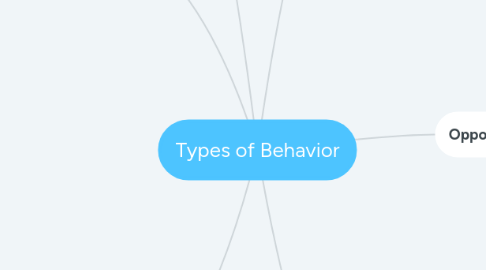
1. Anxiety Disorder
1.1. the student might seem distracted and dreamy
1.2. The student might have poor attendance
1.3. The student might have problems in their group of friends or at home with their families.
1.4. They might benefit from subtle check-ins throughout the day or class.
1.5. Checking in with the child's resource teacher or other teachers so the child feels well-supported.
2. Autism Spectrum Disorder
2.1. Easily distracted, often off-task
2.2. engages in repetitive behavior
2.3. Might stem or flap
2.4. Can be non-verbal or verbal
2.4.1. High functioning/low functioning
2.5. socially awkward
2.6. some students have exceptional memory skills
2.7. Benefit from explicit instruction
2.8. Visual cues and social stories help
2.9. Some students have excellent visual/spatial skills
2.10. Many have strong reading skills
2.11. Benefit from following a daily routine
2.12. Perseveration on interests
3. Obsessive Compulsive Disorder
3.1. Student has obsessions and compulsions
3.2. Student has to perform certain rituals in order to feel safe or keep a family or friend safe.
3.3. Rituals can include: Counting to a certain number, touching or not touching things so many times, saying a word over and over, having things in a certain order, washing and cleaning
3.4. A psychiatrist and medication can help
3.5. Student takes a long time to do everyday tasks ex: get dressed, eat breakfast, often late
3.6. Could benefit from a timer and visual schedule
3.7. Can be very anxious and routine focused
3.8. Trouble enjoying their everyday life especially school
3.9. be mindful with where a student with OCD sits, might feel safer away from a door and closer to the teacher.
3.10. Extended time for tests and projects
3.11. Skip reading out loud and try books on tape.
3.12. Give child advance knowledge of changes in the day if possible to reduce anxiety.
4. ADHD
4.1. Hyperactive and talks non-stop
4.2. Also can be dreamy and quiet ex: without the hyper component
4.3. Can be very impulsive
4.4. Difficulty remembering things ex: always forgetting hmk, lunch, permission forms
4.5. Difficulty following directions, easily bored
4.6. Could have a temper or a short fuse
4.7. Interrupts teacher, friends. Might say the wrong thing at the wrong time.
4.8. visual schedules and timers sometimes help
4.9. Check-ins throughout the day or class
4.10. Adapting the workload so that student can be successful and less overhelmed
4.11. Brain breaks, body breaks, quiet place to calm themselves
5. Oppositional Defiant Disorder
5.1. Extreme defiance towards autority
5.2. Usually have conflict with family, friends, teachers
5.3. Outbursts of temper
5.4. Argumentative
5.5. Might refuse to cooperate before even learning what the activity is
5.6. disobedient at home and school
5.7. Annoys other and is easily annoyed
5.8. Medication sometimes helps, often children have another co-occuring condition for ex ADHD.
5.9. Access to a family doctor and counselor, school resource teacher is vital
6. Bi-Polar Disorder
6.1. Intense mood changes
6.2. Easily excited
6.3. Manic and depressive episdoes
6.4. Student can be very tired because of sleep problems
6.5. Attendance can be poor
6.6. Little motivation to get things done
6.7. Sometimes have poor hygiene if really depressed.
6.8. Hopefully seeing a counselor
6.9. check-ins with the student
6.10. Showing compassion for the student

