

Lung Cancer
par Jocelyn Ormsby
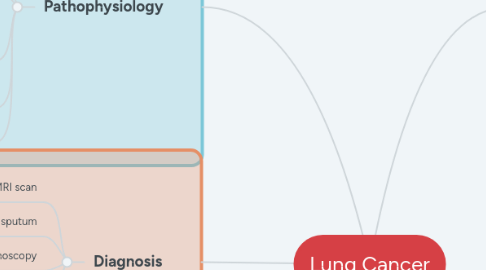
1. Pathophysiology
1.1. overload of carcinogens from smoking or environmental toxins causes pathogenesis of lung cancer
1.2. These toxins paralyze cilia of respiratory tract, slowing down the rate of disposal of carcinogens and bacteria
1.3. Respiratory tract lesions go through genetic and structural changes from hyperplasia, increased mass of cells, to invasive neoplasia, a cancerous mass
1.3.1. These cancer cells then multiply rapidly
1.4. Lesions can also erode epithelium lining and then become a mass in lung tissue
1.5. (Capriotti & Frizzell, 2016)
2. Diagnosis
2.1. Chest x-ray, CT or MRI scan
2.2. Cytological exam of sputum
2.3. Bronchoscopy
2.4. CT- guided tissue biopsy
2.4.1. After biopsy tumor cells can be classified according to stage and spread of cancer
2.5. (Capriotti & Frizzell, 2016)
3. Treatments
3.1. Surgery, radiation, and chemotherapy
3.2. Stage 1, 2, and localized NSCLC- surgery is recommended
3.3. Common surgery is the removal of an entire lobe of one lung
3.4. (Capriotti & Frizzell, 2016)
4. Risk Factors
4.1. Smoking
4.2. Asbestos Exposure
4.2.1. Asbestos can cause mesothelioma on pleural membrane
4.3. Radon Exposure
4.4. first-degree family member with lung cancer doubles risk of having lung cancer
4.5. History of:
4.5.1. COPD
4.5.2. pulmonary fibrosis
4.5.3. radiation therapy to the chest