

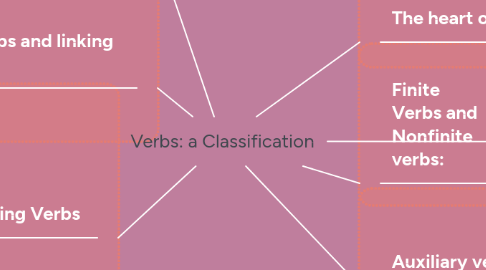
1. Predicating verbs and linking verbs
1.1. A predication is what is said of the subject, the predication is accomplished by the verb.
1.1.1. Peter walks - Peter walks Slow- Peter walks through the cinema.
1.2. Linking verb is a word or exxpression that links a subject with its predicate.
1.2.1. You look happy- My favorite veggies are tomatoes and carrots.
2. Linking Verbs
2.1. verbs that express a state of being, all forms of the verb -Be- are always linking verbs.
2.1.1. The flower looks beautiful- The cake smells good.
2.2. Copular verbs
2.2.1. verbs which do not normally take objects, require a phrase or word to make their meaning complete.
2.2.1.1. She acted well- I am feeling unwell
2.3. Copulative verbs
2.3.1. Is a verb form that joins a subject to an adjective or to another noun; verb To Be.
2.3.1.1. John is my friend (noun)- John is happy (adjective)
3. Predicating verbs - Transitivity
3.1. Go across, when we use a transitive verb, action passes from the subject across the verb to an object of the verb.
3.1.1. Verbs that require objects to complete their meaning.
3.1.1.1. Please bring coffee- The girls carry water to their village
4. Be: is used to other verbs to form continous tenses and the passive voice.
4.1. She is reading a magazine.
5. The heart of communication:
5.1. The verbs are the starting point, the basis on which other definitions rest.
5.1.1. Love- look-touch
6. Finite Verbs and Nonfinite verbs:
6.1. Finite verbs: defined as verbs which can make a statemen about a subject
6.1.1. Amely died- Dewey Retired
6.2. Non-Finite verbs: Defined as a verb that cannot in itself make a statement
6.2.1. Amely dying- Dewey to retire
7. Auxiliary verbs
7.1. The auxiliary verbs help to form various tenses, moods and voices of other verb; BE- HAVE- DO.
7.1.1. Have: is used to make perfect tenses
7.1.1.1. The Judge had asked her to speak up.
7.1.2. Do: is used for emphasis and make questions.
7.1.2.1. He did look tired- Do you want a coffee?