


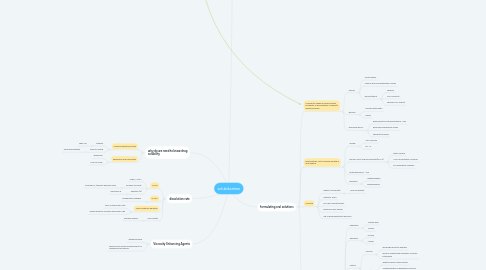
1. improvement of
1.1. cosolvents
1.2. pH adjustment
1.2.1. route of administration
1.2.2. drug stability
1.2.2.1. ionization of drug increases solubility
1.2.2.1.1. buffers help push drug toward ionized form
1.2.2.1.2. drug salts quickly ionize
1.2.2.1.3. drug salts disassociate quickly in water
1.2.3. drug PKA
1.2.3.1. adjusting pH adjusts solubility based on ionization
1.3. drug salts
1.4. solubilization with surfactants
2. why do we need to know drug solubility
2.1. compounding/production
2.1.1. stability
2.1.1.1. shelf life
2.1.2. order of mixing
2.1.2.1. avoid precipitation
2.2. absorption and elimination
2.2.1. dispersion
2.2.2. Low pH drugs
3. dissolution rate
3.1. in vivo
3.1.1. High c, Low T
3.1.2. increase viscosity
3.1.2.1. increases H, thickens diffusion layer
3.1.3. agitation (h)
3.1.3.1. decreases h
3.2. in vitro
3.2.1. temperature changes
3.3. Noye's Whitney Equation
3.3.1. tells us dissolution rate
3.3.2. smaller particles increase dissolution rate
3.4. Flocculation
3.4.1. avoiding caking
4. Viscosity Enhancing Agents
4.1. methylcellulose
4.2. helps ensure proper measurement for dispensing and dosing
5. formulating oral solutions
5.1. cosolvents: enhance drug solubility, possibility of precipitation if added to aqueous quickly
5.1.1. alcohol
5.1.1.1. most popular
5.1.1.2. used to dissolve hydrophobic drugs
5.1.1.3. has limitations
5.1.1.3.1. children
5.1.1.3.2. OTC products
5.1.1.3.3. adverse CNS affects
5.1.2. glycerol
5.1.2.1. miscible with water
5.1.2.2. sweet
5.1.3. propylene glycol
5.1.3.1. high amounts contraindicated in <4yo
5.1.3.2. dissolves hydrophobic drugs
5.1.3.3. oderless/colorless
5.2. preservatives: limit microbial growth in drug vehicle
5.2.1. alcohol
5.2.1.1. 15% common
5.2.1.2. pH <5
5.2.2. benzoic acid/ sodium benzoate (pH<5)
5.2.2.1. water soluble
5.2.2.2. 10% concentration common
5.2.2.3. pH dependent solubility
5.2.3. propylene glycol ~10%
5.2.4. parabens
5.2.4.1. methylparaben
5.2.4.2. propylparaben
5.3. Coloring
5.3.1. makes it look pretty
5.3.1.1. nicer for patient
5.3.2. match to flavor
5.3.3. Azo dyes yellow/sunset
5.3.4. quinolone dyes yellow
5.3.5. risk of hypersensitivity reactions
5.4. sweeteners:improve palatibility of drug
5.4.1. pediatrics
5.4.1.1. bubble gum
5.4.1.2. berries
5.4.2. geriatrics
5.4.2.1. licorice
5.4.2.2. coffee
5.4.3. natural
5.4.3.1. sucrose
5.4.3.1.1. avoid high amounts diabetic
5.4.3.1.2. avoid in patient with hereditary fructose intolerance
5.4.3.2. soribitol
5.4.3.2.1. laxative effect unless diluted
5.4.3.2.2. contraindicated in hereditary fructose intolerance
5.4.3.2.3. ok for diabetic
5.4.3.3. mannitol
5.4.4. artifical
5.4.4.1. saccharin
5.4.4.2. aspartame
5.4.4.2.1. caution in use with patients with headaches/migraines
5.4.4.2.2. 150-200 times as sweet as sucrose
5.4.5. diabetic syrups
5.4.5.1. methylcellulose
5.4.5.2. hydroxyethyl celluslose
5.4.5.3. sodium CMC
5.4.5.4. saccharin and aspartame
5.4.5.4.1. improved palatibility
5.4.5.4.2. bitter aftertaste