


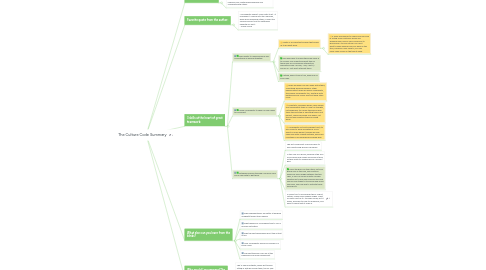
1. 1-Sentence-Summary:
1.1. The Culture Code examines the dynamics of groups, large and small, formal and informal, to help you understand how great teams work and what you can do to improve your relationships wherever you cooperate with others.
2. Favorite quote from the author:
2.1. "Vulnerability doesn't come after trust - it precedes it. Leaping into the unknown, when done alongside others, causes the solid ground of trust to materialize beneath our feet." - Daniel Coyle
3. 3 skills at the heart of great teamwork:
3.1. Build safety to make everyone feel comfortable in working together.
3.1.1. Safety is an important enabler that allows us to do great work.
3.1.1.1. A work environment in which you feel safe in acting as you naturally would and speaking your mind is very conducive to group work. It’s only natural: you don’t want to keep looking over your back all the time, because if you need to, you can never really focus on the task at hand.
3.1.2. One good way to make others feel safer is to confirm you understand what they’re telling you by occasionally interjecting affirmations like “uh-huh,” “yes,” “got it,” and so on. Just don’t interrupt them.
3.1.3. Instead, when it’s your turn, share one of your flaws.
3.2. Share vulnerability to show no one needs to be perfect.
3.2.1. When we share our own flaws with others, something amazing happens. Other people detect when we signal vulnerability, thus signal vulnerability too, and thus both parties become closer and trust each other more.
3.2.2. Scientists, like Brené Brown, have shown that vulnerability itself is a sign of strength, not weakness. It’s usually the person who takes the first step in admitting they’re not perfect, who’s perceived as a leader, not the one who berates others for being weak.
3.2.3. Vulnerability not just increases trust, it’s also a way to show acceptance: if you admit no one’s perfect, people will feel okay even after making mistakes, which are inevitable in accomplishing a shared goal.
3.3. Establish purpose through a common goal and a clear path to get there.
3.3.1. The last component Coyle ascribes to well-functioning groups is purpose.
3.3.2. In the case of a group, purpose is the sum of all beliefs and values among your team, as they relate to achieving your common goal.
3.3.3. Since the goal is in the future, but your group lives in the now, your purpose should be like a bridge between the two. Thus, if you can come up with a simple narrative as to how your purpose will help you go from today to tomorrow and reach your goal, you’ll be able to activate those around you.
3.3.4. A useful tool to accomplish this is a short, catchy, maybe even cheesy slogan. Think of Nike’s “just do it.” It’s kinda cliché, but it works, because it’s easy to remember, and easy to repeat until it sinks in.