

1. Week 1
1.1. Objective: Students will be able to explain basic concepts in assessment.
1.1.1. NCLB: No Child Left Behind was intended to promote high standards, close the achievement gap, and increase accountability.
1.1.1.1. ESEA: The Elementary and Secondary Education Act was - at the time - the federal governments most serious commitment to providing all the nation's K-12 youth with equal access to high-quality education.
1.1.1.1.1. ESSA: Every Student Succeeds Act: US law passed in December 2015 that governs the United States K–12 public education policy.
2. Week 2
2.1. Objective: Students will be able to explain basic concepts in assessment.
2.1.1. Cognition: refers to the mental processes and activities underlying proficiency in a given knowledge domain.
2.1.1.1. Observation: refers to the kinds of tasks that elicit from students responses that show competence in the knowledge domain assessed.
2.1.1.1.1. Interpretation: refers to the different patterns of student responses that correspond to varying levels of student competence.
3. Week 3
3.1. Objective: Students will be able to identify who are multilingual learners and why we assess in multiple languages.
3.1.1. Multilingual learners: Students who are developing proficiency in multiple languages.
3.1.1.1. Multilingual education: refers to "first-language-first" education, that is, schooling which begins in the mother tongue and transitions to additional languages.
3.1.1.1.1. Multilingualism: Generally understood to mean knowledge of more languages than a native language.
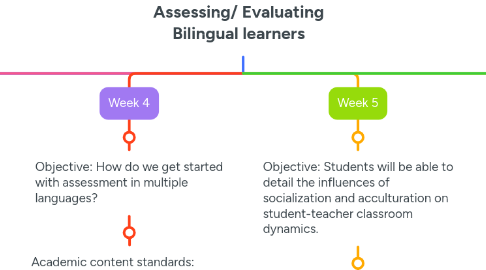
4. Week 4
4.1. Objective: How do we get started with assessment in multiple languages?
4.1.1. Academic content standards: These define what students should know and be able to do. States adopt challenging academic content standards for all students that identify what students need to know and do.
4.1.1.1. Summative assessment: These define what students should know and be able to do. States adopt challenging academic content standards for all students that identify what students need to know and do.
4.1.1.1.1. High-stakes testing: a test with important consequences for the test taker. Passing has important benefits, such as a high school diploma, a scholarship, or a license to practice a profession.
5. Week 5
5.1. Objective: Students will be able to detail the influences of socialization and acculturation on student-teacher classroom dynamics.
5.1.1. Acculturation: a natural process of adaption to a new cultural and social environment.
5.1.1.1. Enculturation: The initial socialization to the norms of our culture or group.
5.1.1.1.1. Culture Shock: the feeling of disorientation experienced by someone who is suddenly subjected to an unfamiliar culture, way of life, or set of attitudes.
6. Week 6
6.1. Objective: Students will be able to use language assessment results to inform their instructional planning delivery.
6.1.1. Language acquisition: the process of becoming successful at understanding and using language.
6.1.1.1. Form: the structural aspect of language that involves attaching some symbols to the meaning being expressed.
6.1.1.1.1. Syntax: refers to language-appropriate word order.
7. Week 7
7.1. Objective: Students will be able to justify use of alternative and authentic assessment in todays classroom.
7.1.1. Reliability: is best understood as the power of an assessment to gather consistent evidence of skill, regardless of the examiner, time, place, or other variables related to its administration.
7.1.1.1. Validity refers to the ability to of an assessment, process, or product to measure the knowledge or skill it is intended to measure.
7.1.1.1.1. Performance based assessments: encompass a variety of ways to observe and monitor students learning over time.
8. Week 8
8.1. Objective: Student will be able to plan classroom assessment in multiple languages.
8.1.1. Cross-linguistic: of or relating to languages of different families and types especially : relating to the comparison of different languages.
8.1.1.1. Cross-cultural: relating to different cultures or comparison between them.
8.1.1.1.1. Assessment of learning: occurs when teachers use evidence of student learning to make judgments on student achievement against goals and standards.