


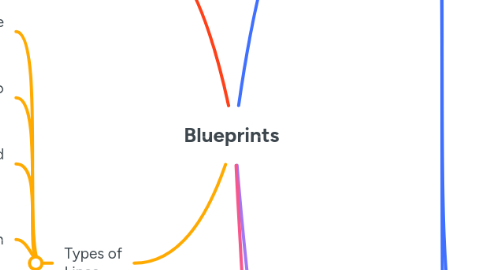
1. drawings
1.1. floor plans
1.1.1. varied height 1/4'' to 1'
1.1.2. a horizontal slice through the building at about 4-5ft
1.1.3. varied height so it shows the most detail
1.1.4. shows Horizontal measurements, room size, wall thickness, cupboard length, stairway width, etc.
1.1.5. Location of walls, partitions, stairwells, doors, windows
1.1.6. Room numbers (found approx. the center of the room)
1.2. elevation
1.2.1. typically 4 sides(north,east etc.) shows type of roof
1.2.2. Drawings of the exterior of the building as viewed from each side.
1.2.3. Drawn to the same scale as the floor plan and cross sections.
1.2.4. Show the shape & size of the building, slope of the roof, location of trees, walkways, and patios. The exterior finishes, brick, wood, stucco, shingles.
1.2.5. Type of roof – Flat, steep, mansard, barrel, etc.
1.2.6. Vertical dimensions – Height of building, chimney, footings, roof decks, etc.
1.2.7. Location of – Doors, windows, gutters, down spouts, or anything visible from the exterior of the building
1.3. cross sections
1.3.1. shows roof deck,trusses,insulation
1.3.2. A cut away view which shows an elevation view of the interior of a building from top to bottom.
1.3.3. Show thickness of the floor. The roof deck, trusses, and ceiling construction.
1.3.4. also shows Insulation, Wall construction and material. Floor to ceiling height. Depth and type of footing & foundation.
1.4. detail drawings
1.4.1. shows important details magnified
2. Scales
2.1. use architect scale to accurately measure sizes (scales) on blueprints.
3. A.M.E.S.S.
3.1. Architectural: Includes floor plan, elevation, cross-sections, and detail drawings
3.2. Mechanical: Drawn by a mechanical engineer. Includes the plumbing, heating, HVAC etc.
3.3. Electrical: Drawn by an electrical engineer. Includes outlets, lights, power sources etc.
3.4. Structural: Drawn by a structural engineer. Includes the columns, beams, foundation etc.
3.5. Site Plan: Shows plot of land on which building is built. Water lines, gas, sewage. drainage sidewalks etc.
4. Types of Lines
4.1. Object Line: Thick continuous line used to outline visible edges
4.2. Hidden Line: Short dashes used to make drawing easier to view
4.3. Section Line: Shows section and drawing of certain things
4.4. Center Line: Long, short, long, short. Not to be confused with hidden line
4.5. Dimension Line: Used to show size
4.6. Extension line: The limit of dimensions
4.7. Leader Line: Shows certain part of object
4.8. Break Line: used to remove or "break" out part of a drawing
5. Types of Drawings
5.1. Isometric
5.1.1. drawings stand on corner
5.2. Oblique
5.2.1. runs paralell to page
5.3. Perspective
5.3.1. vanishing points