

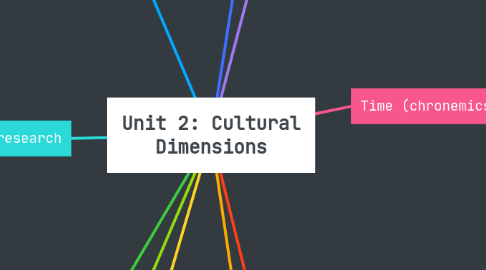
1. Non-verbal communication
1.1. Eye contact (oculistics)
1.2. Touch (haptics)
1.3. Body distance (proxemics)
1.4. Paralanguage
1.4.1. words
1.4.2. tone of voice
1.4.3. the speed or pitch of what we say
1.5. Turn-taking
1.6. Body language (kinesics)
1.6.1. Body movement
1.6.2. body position
1.6.3. facial expressions
1.6.4. dress
2. Survey of research
2.1. Edward Hall
2.2. Kluckhohn and Strodtbeck
2.3. Hofstede
2.4. Trompenaars
3. Individual and group
3.1. Individualism
3.1.1. Collectivist cultures
3.1.1.1. - identity is based on the social network to which you belong - harmony should be maintained - communication is high context - employer—employee relationships are like a family link - decisions on employing people take the group into account - management is management of groups - relationship is more important than task
3.1.2. Individualist cultures
3.1.2.1. - identity is based on the individual - honest people speak their mind - communication is low context - employer-employee relationships are based on a contract - decisions to employ people take skills into account - management is management of individuals - task is more important than relationship
3.2. Universalism and particularism
3.2.1. A universalist always help their friends
3.2.2. The particularist would not even help their friends.
4. Communication style
4.1. Context
4.1.1. high-context
4.1.1.1. physical context or internalized in the person
4.1.2. low-context
4.1.2.1. explicit code
4.2. Directness
4.2.1. Blur the sender
4.2.2. Blur the receiver
4.2.3. Blur the message
4.3. Person and task
5. Space
5.1. Cottle circle test
5.2. Visualization of time
5.3. Office space
6. Uncertainty
6.1. Weak uncertainty
6.1.1. • uncertainty is a normal feature of life • there should not be more rules than necessary • tolerance of innovative ideas • motivation by achievement
6.2. Strong uncertainty
6.2.1. • uncertainty is a threat • people fear ambiguous situations • there is an emotional need for rules • resistance to innovation • motivation by security
7. Nature
7.1. Control: people can dominate their environment
7.2. Harmony: people should live in harmony
7.3. Constraint: people are constrained by the world around them
8. Time (chronemics)
8.1. Polychronic and monochronic
8.1.1. polychronic cultures
8.1.1.1. acceptable to do several things at the same time
8.1.1.2. approach to deadlines is flexible
8.1.2. monochronic cultures
8.1.2.1. one thing is done at a time
8.1.2.2. stress deadlines
8.2. Linear, cyclical and event-related
8.2.1. Linear concept of time
8.2.1.1. time can be saved, spent, wasted, or lost
8.2.1.2. the product of an industrial society
8.2.1.3. required the precise measurement of time, planning, and discipline
8.2.2. Cyclical concept of time
8.2.2.1. inspired by the daily and yearly routines of agricultural life
8.2.2.2. people should adapt to natural cycles.
8.2.2.3. time is not as a scarce resource
8.2.3. Event-related concept of time
8.2.3.1. time is when something happens.
8.2.3.2. Time cannot be wasted or saved
8.3. Past, present, and future
8.3.1. short- term orientation
8.3.1.1. -respect for traditions -people prepared to overspend to keep up with their neighbours - small amount of savings - people expect quick results.
8.3.2. long-term orientation
8.3.2.1. -traditions adapted for modern context - people thrifty - large amount of savings - people persevere for slow results.
9. Power
9.1. Small power distance cultures
9.1.1. -people want to minimize inequality - decentralization is popular - there is a narrow range of salaries - subordinates expect to be consulted - the ideal boss is a democrat - people disapprove of status
9.2. Large power distance cultures
9.2.1. -inequalities are expected and welcomed - centralization is popular - there is a wide range of salaries - the ideal boss is an autocrat - privileges for managers are expected.
10. Male and female
10.1. feminine cultures
10.1.1. • caring for others is a dominant value • relationships are important • people should be modest • both men and women deal with facts and feelings • people work to live • managers aim for consensus • equality, solidarity, and quality are important at work • conflicts are solved by compromise.
10.2. Masculine cultures
10.2.1. • material success is a dominant value • things are important • men are assertive • women deal with feelings • people live to work • managers are expected to be decisive • competition and performance are important at work • conflicts are fought out.