


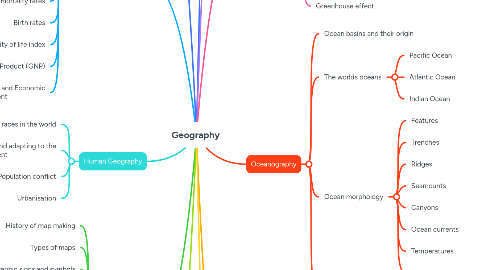
1. Bio-Geography
1.1. Food chains
1.2. Darwens Theory of Evolution
1.3. Biomes
1.4. Global plant distribution
1.5. Global animal distribution
1.6. Habitat decay
1.7. Habitat conservation
1.8. Environmental impacts
2. Population Geography
2.1. Population Data
2.2. Population distribution
2.3. Population Growth
2.4. The seven continents and population composition
2.5. Rural and Urban population
2.6. Migration
2.7. Mortality rates
2.8. Birth rates
2.9. Quality of life index
2.10. Gross National Product (GNP)
2.11. Population and Economic development
3. Human Geography
3.1. Human races in the world
3.2. Humans and adapting to the environment
3.3. Population conflict
3.4. Urbanisation
4. Cartography
4.1. History of map making
4.2. Types of maps
4.3. Cartographic signs and symbols
4.4. Topgraphic mapping
4.5. Mapping of climatic data
4.6. Weather maos and their interpretation
4.7. Population maps
4.8. Industry maps
4.9. Physical maps
4.9.1. Rivers of the world
4.9.2. Mountains of the world
4.9.3. Oceans, seas and lakes
4.10. Political maps
5. Political Geography
5.1. Emergence of states
5.2. Political boundaries
5.3. International organisations
5.4. International tensions
5.5. Conflict
6. Introduction to Geography
6.1. What is Geography?
6.1.1. Terrestrial Ecosystems
6.1.2. Satellite images
6.1.3. Aerial photography
6.1.4. Marine Ecosystems
6.1.5. Freshwater Ecosystems
6.2. Natural Hazards
7. Physical Geography
7.1. The interior of the Earth
7.2. Continental drift
7.3. Plate Techtonics
7.4. Earthquakes
7.5. Volcanoes
7.6. Rock types and formation
7.7. Minerals
7.8. Erosion
7.9. Transportation and Deposition
7.10. Fluvial features
7.11. Glacial features
7.11.1. Glaciers
7.12. Coastal features
7.13. Lakes and Rivers
7.13.1. Stream and river types
7.13.1.1. River basins
7.13.1.1.1. Estuaries - where fresh meets salt water
7.14. Geysers and hot springs
7.15. Mountain types
7.15.1. The Alps
7.15.2. The Andes
7.15.3. The Himalayas
7.15.4. The Rockies
7.15.5. The Andes
8. Climatology
8.1. Earth's atmosphere
8.2. Weather and Climate
8.2.1. The Water Cycle
8.3. Weather forecasting
8.4. Rainfall
8.4.1. World patterns of rainfall
8.5. Atmospheric pressure and winds
8.6. Cloud formation
8.6.1. Cloud types
8.7. Atmospheric pollution
8.8. Climate change
8.9. Greenhouse effect
9. Oceanography
9.1. Ocean basins and their origin
9.2. The worlds oceans
9.2.1. Pacific Ocean
9.2.2. Atlantic Ocean
9.2.3. Indian Ocean
9.3. Ocean morphology
9.3.1. Features
9.3.2. Trenches
9.3.3. Ridges
9.3.4. Seamounts
9.3.5. Canyons
9.3.6. Ocean currents
9.3.7. Temperatures
9.3.8. Coral reefs and Atolls
9.4. Oceanographic exploration
10. Economic Geography
10.1. Natural resources
10.2. The World Trade Organisation (WTO)
10.2.1. Globalisation
10.2.2. Trade and Transport
10.2.3. Industrial revolution
10.2.4. Green revolution
10.2.5. Oil and natural gas
10.2.6. Renewable energy
10.3. Conservation of resources
10.4. Resources in the soil
10.5. Resources in water
10.6. Resources in the world's forests
10.7. Mineral resources
10.8. Energy resources
10.9. Agricultural types
10.9.1. Major food crops
10.9.2. Major cash crops
10.9.3. Dairy farming
10.9.4. Mixed farming
10.10. Mineals and industries
10.10.1. Iron and steel
10.10.2. Textile
10.10.3. Engineering
10.10.4. Chemical