
Nervous system

Central nervous system and Pripheral nervous system

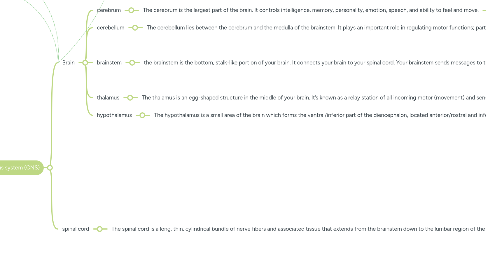
1. Brain
2. consists of axons, which are long cords that extend from the nerve cells. They are coated in myelin, a fatty substance that insulates the axons to help electrical messages travel faster down the axons
3. white matter
4. Grey matter
5. central nervous system (CNS)
5.1. Brain
5.1.1. cerebrum
5.1.1.1. The cerebrum is the largest part of the brain. It controls intelligence, memory, personality, emotion, speech, and ability to feel and move.
5.1.1.1.1. It is divided into left and right hemispheres (halves), which are linked by a band of nerve fibres in the centre of the brain called the corpus callosum.
5.1.2. cerebellum
5.1.2.1. The cerebellum lies between the cerebrum and the medulla of the brainstem. It plays an important role in regulating motor functions; participating in the planning and modulation of motor activity, including the coordination of the body while moving.
5.1.2.1.1. the cerebellum has two hemispheres (left and right). They are connected by a midline mass called the vermis. It also has three lobes; anterior, posterior and flocculonodular.
5.1.3. brainstem
5.1.3.1. the brainstem is the bottom, stalk-like portion of your brain. It connects your brain to your spinal cord. Your brainstem sends messages to the rest of your body to regulate balance, breathing, heart rate and more.
5.1.3.1.1. Midbrain
5.1.3.1.2. Pons
5.1.3.1.3. medulla oblongata
5.1.4. thalamus
5.1.4.1. The thalamus is an egg-shaped structure in the middle of your brain. It’s known as a relay station of all incoming motor (movement) and sensory information — hearing, taste, sight and touch (but not smell) — from your body to your brain
5.1.4.1.1. The thalamus moves information to and from the lobes, and controls movements and memory.
5.1.5. hypothalamus
5.1.5.1. The hypothalamus is a small area of the brain which forms the ventral/inferior part of the diencephalon, located anterior/rostral and inferior/ventral to the thalamus. Although it weighs only about 4 g, it controls a wide range of vital functions of the human body (e.g. homeostasis, energy consumption, hunger, awareness etc...) via its connections with the endocrine system, autonomic nervous system and limbic system.
5.2. spinal cord
5.2.1. The spinal cord is a long, thin, cylindrical bundle of nerve fibers and associated tissue that extends from the brainstem down to the lumbar region of the vertebral column.
5.2.1.1. Anatomy
5.2.1.1.1. Gray matter
5.2.1.1.2. White matter
5.2.1.2. Function
5.2.1.2.1. Sensory Processing
5.2.1.2.2. Motor Control
5.2.1.2.3. Autonomic Functions
5.2.1.3. Protection
5.2.1.3.1. Vertebral Column
5.2.1.3.2. Cerebrospinal Fluid (CSF)
5.2.1.3.3. Meninges
6. peripheral nervous system (PNS)
6.1. The peripheral nervous system (PNS) is composed of all the nervous structures outside the brain and spinal cord.
6.1.1. Somatic Nervous system
6.1.1.1. Controls voluntary movements
6.1.1.1.1. Sensory (Afferent) Neurons
6.1.1.1.2. Motor (Efferent) Neurons
6.1.2. Autonomic Nervous system (ANS)
6.1.2.1. Controls involuntary functions
6.1.2.1.1. Sympathetic Nervous System (SNS)
6.1.2.1.2. Parasympathetic Nervous System (PSNS)
6.1.2.1.3. Enteric Nervous System
6.2. 43 Nerves
6.2.1. Cranial Nerves
6.2.1.1. 12 pairs
6.2.2. Spinal Nerves
6.2.2.1. 31 pairs