
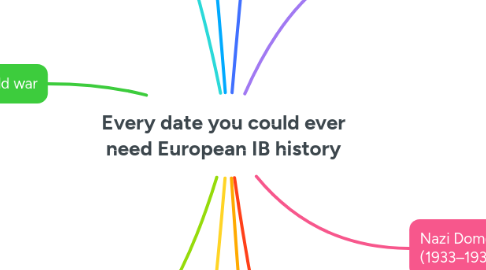
Every date you could ever need European IB history

This is a mind map with all the key dates needed to answer an IB paper 3 History question

1. Cold War (1947-1991)
1.1. Aliances
1.1.1. NATO
1.1.1.1. North Atlantic Treaty Organisation
1.1.2. Warsaw pact
1.1.2.1. All countries in USSR will fight for the USSR
1.2. Consequences
1.2.1. Deterrence
1.2.2. Rivarly
1.2.2.1. Space Race
1.2.2.1.1. USSR launches satellite Sputnik
1.2.2.1.2. Yuri Gagarin goes to space
1.2.2.1.3. USA lands on the moon
1.2.2.2. Arms Race
1.2.2.2.1. Both sides build up their armies and increased the sizes of their weapons arsenals
1.2.3. Conflicts
1.2.3.1. Cuban Missile Crisis
1.2.3.1.1. Bay of Pigs was invaded by the USA
1.2.3.1.2. The purpose was to cause a revolt against Castro
1.2.3.1.3. Krushchev placed nuclear missiles in Cuba
1.2.3.1.4. USA also have placed missiles in Turkey
1.2.3.1.5. This crisis almost resulted in Mutual Assured Destruction, but it was solved
2. Wars
2.1. During the cold war
2.1.1. Wasn't quite a Proxy war
2.1.1.1. Vietnam War
2.1.1.1.1. USA fights
2.1.1.1.2. USA brings troops into Vietnam
2.1.2. Was a series of proxy wars
2.1.2.1. USA and USSR hold huge arsenals of nuclear weapons to prevent war
2.1.2.1.1. each side knew that neither of them would launch a nuclear attack since both knew that the other side could strike back with devastated power
2.1.2.2. Korean War
2.1.2.2.1. USA supporting South Korea
2.1.2.2.2. USSR supporting North Korea
3. Sides in the cold war
3.1. USSR
3.1.1. Communist
3.1.2. Anti-democratic
3.2. USA
3.2.1. Capitalist
3.2.2. Anti-communist
3.2.2.1. RED SCARE
3.2.3. Helped economically countries
3.2.3.1. In order for them to not be communist
3.2.3.2. Creating satellite states
4. Alliances
4.1. NATO
4.1.1. North Atlantic Treaty Organization
4.1.2. By USA
4.1.3. To strengthen the Western Allies
4.2. Warsaw Pact
4.2.1. By USSR
4.2.2. In response to the creation of NATO
4.2.3. Alliance of Eastern communist countries
5. Main Characters
5.1. Winston Churchill
5.1.1. Great Britain leader
5.1.2. Iron curtain author
5.2. Harry S Truman
5.2.1. National security Act
5.2.1.1. CIA
5.2.1.2. Pentagon
5.2.2. Atomic bomb is created in his time
5.2.3. He bombs Japan x2
5.3. John F Kennedy
5.3.1. US president
5.3.2. Helped defusing the Cuba Missile Crisis
5.3.3. Got assasinated
5.4. Joseph Stalin
5.4.1. USSR leader
5.4.2. He was one of the main reasons of the creation of the Cold War
5.4.2.1. COLECTIVISATION & INDUSTRIALISATION
5.4.2.1.1. 5 year plans
5.5. Nikita Krushchev
5.5.1. Successor of Stalin
5.5.2. Lead the USSR during Cold War
5.5.2.1. Cuban Missle Crisis
5.6. Leonid Brezhnev
5.6.1. General Secretary of USSR
5.6.2. He brought back Cold War tensions
5.6.2.1. Economic stagnation
5.6.3. GULAG ARCAPELAGO
6. The Rise of Hitler and the Nazi Party (1919–1933)
6.1. 1919: Treaty of Versailles (June 28) – Harsh reparations and territorial losses humiliate Germany, creating resentment.
6.2. 1919: Hitler joins the German Workers’ Party in September, which later becomes the Nazi Party.
6.3. 1920: Nazi Party introduces the 25-Point Program, outlining key policies, including anti-Semitism, nationalism, and rejection of the Treaty of Versailles.
6.4. 1923: Hyperinflation Crisis – German economy collapses, worsening economic discontent.
6.5. 1924: Hitler writes Mein Kampf in prison, outlining his ideology and goals for Germany.
6.6. 1925: Hitler rebuilds the Nazi Party after his release, focusing on legal political participation.
6.7. 1929: Great Depression hits, leading to mass unemployment and increased support for extremist parties.
6.8. 1932: Nazi Party wins 230 seats in the Reichstag (July) and becomes the largest party in parliament.
6.9. 1933: Hitler appointed Chancellor of Germany (January 30).
7. Consolidation of Power (1933–1934)
7.1. 1933: Reichstag Fire (February 27) – Nazis blame Communists, leading to the Reichstag Fire Decree that restricts civil liberties.
7.1.1. Enabling Act (March 23) – Allows Hitler to enact laws without Reichstag approval, effectively giving him dictatorial power. Gestapo (Secret Police) is established in April to target opposition. First Concentration Camp at Dachau (March) – Initially for political prisoners. Boycott of Jewish Businesses (April 1) – The first antisemitic policy targeting Jews in Germany.
7.2. 1934: Night of the Long Knives (June 30 - July 2) – Purge of the SA (Nazi paramilitary) and other opponents to solidify Hitler’s control.
7.2.1. Death of President Hindenburg (August 2) – Hitler merges the positions of Chancellor and President, declaring himself Führer.
8. Nazi Domestic and Social Policies (1933–1939)
8.1. 1935: Nuremberg Laws (September 15) – Strips Jews of citizenship, prohibits marriage or sexual relations between Jews and Germans.
8.1.1. Rearmament begins in defiance of the Treaty of Versailles, creating jobs and building military strength.
8.2. 1936 Four-Year Plan – Initiated to make Germany economically self-sufficient and prepare for war.
9. Nazi Foreign Policy and Expansionism (1933–1939)
9.1. 1933: Germany withdraws from the League of Nations – a symbolic rejection of international cooperation.
9.2. 1936: Remilitarization of the Rhineland (March 7) – German troops move into the demilitarized Rhineland, a major violation of the Treaty of Versailles.
9.3. 1938: Anschluss with Austria (March 12) – Germany annexes Austria.
9.3.1. Munich Agreement (September 30) – Britain and France appease Hitler by allowing Germany to annex the Sudetenland region of Czechoslovakia.
9.4. 1939Nazi-Soviet Pact (August 23) – Non-aggression pact with the Soviet Union, secretly dividing Eastern Europe between the two powers. Invasion of Poland (September 1) – Germany’s invasion marks the beginning of WWII; Britain and France declare war on German
10. World War II Timeline (1939–1945) Just the key events
10.1. 1940 Tripartite Pact (September 27) – Alliance signed between Germany, Italy, and Japan.
10.2. 1941: Operation Barbarossa (June 22) – Germany invades the Soviet Union.
10.2.1. Attack on Pearl Harbor (December 7) – Japan attacks the U.S., and Germany declares war on the U.S.
10.3. Big Dates (Turning points)
10.3.1. 1942: Wannsee Conference (January 20) – Nazi leaders formalize the “Final Solution” plan for the mass extermination of Jews.
10.3.1.1. Battle of Stalingrad (July 1942 - February 1943) – Major Soviet victory, marking a turning point in the war.
10.3.2. 1944: D-Day Invasion (June 6) – Allied forces land in Normandy, beginning the liberation of Western Europe.
10.3.2.1. Attempted Assassination of Hitler (July 20) – German officers’ plot to kill Hitler fails.
10.3.3. 1945: Soviets enter Berlin (April)
10.3.3.1. Hitler’s Suicide (April 30) – As defeat becomes imminent, Hitler kills himself in his bunker.
10.3.3.1.1. Germany surrenders (May 7) – Known as V-E Day (Victory in Europe Day).