

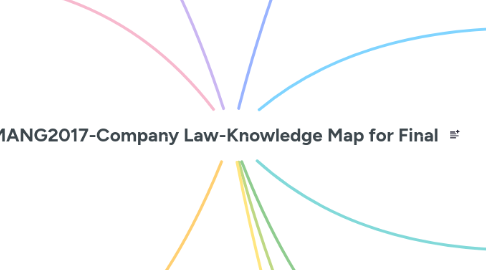
1. Topic 1: Types of Business Entities
1.1. Types of business entity
1.1.1. Sole trader
1.1.2. General Partnership
1.1.2.1. Duties of partners
1.1.3. Limited liability partnership (LLP)
1.2. the advantages vs disadvantages
1.3. Duties of partners
2. Topic 2: Limited Companies and Incorporation
2.1. The role of promoter
2.2. Incorporation documents
2.3. Pre-incorporation contracts
3. Topic 3: Constitution of A Company
3.1. Lifting the veil of incorporation
3.1.1. Seminar 3:Q1&Q2
3.2. Articles of Association
3.2.1. Binding Power of the Constitution
3.2.1.1. Seminar 3: Q5
3.2.2. Seminar 3: Q3
3.2.3. Amendments of Articles
4. Topic 4: Shares, Debentures and Charges
4.1. Charges
4.1.1. Fixed charges
4.1.2. Floating charges
4.2. Shares
4.2.1. Rights of ordinary shareholders/members with different shareholding precentages
4.2.1.1. 5%
4.2.1.2. 10%
4.2.1.3. 25%
4.2.1.4. 50%
4.2.1.5. 75%
4.2.1.6. 100%
5. Topic 5: Company Officers
5.1. Directors
5.1.1. Different types of directors
5.1.1.1. Executive Directors
5.1.1.1.1. Finance Directors
5.1.1.1.2. Managing Directors
5.1.1.1.3. Sales Directors
5.1.1.2. Non-executive Directors
5.1.1.3. Alternate Directors
5.1.1.4. de factor Directors
5.1.1.5. Shadow Directors
5.1.2. Key statutory duties
5.1.3. Breaching of duties
6. Topic 6-Audit
6.1. Duties and rights of the auditor in CA 2006
6.2. Unqualified or qualified opinion
6.3. Qualification and independence
6.4. The procedures of removing auditors
7. Topic 7: AGM, Resolutions and Account
7.1. Types of company meetings
7.2. Purposes of meeting
7.3. Notice requirements
7.4. Resolutions
7.5. Protection of minority shareholders
8. Topic 8-Corporate Governance
8.1. UK Corporate Governance Code
8.2. Main principles: Board Leadership and Corporate Purpose
8.2.1. Five Principles
9. Topic 9: Liquidation
9.1. Voluntary vs compulsaory liquidation
9.2. Distribution of company assets
10. Topic 10: Administration
10.1. Wrongful trading
10.2. Administrator
10.2.1. The role of adminstrator
10.2.2. The possible options upon appointment