

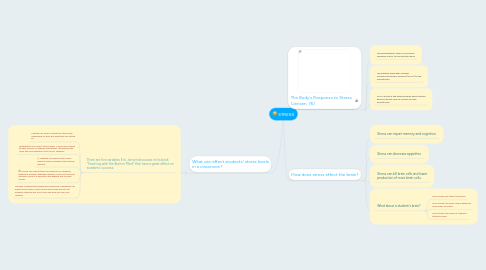
1. What can affect students' stress levels in a classroom?
1.1. There are five variables Eric Jensen discusses in his book "Teaching with the Brain in Mind" that have a great effect on academic success.
1.1.1. Seating can affect a student's stress level depending on who and what they are sitting by.
1.1.2. Temperature can affect stress levels. Classrooms should be kept around 70 degrees Fahrenheit. The warmer the room the more stressful it can be for students.
1.1.3. Lighting can affect stress levels. Indirect natural sunlight is the best for learning.
1.1.4. Noises can affect stress and learning for students, especially English Language Learners. The most common stressful noise in a classroom are heating and cooling noises.
1.1.5. The way in which the building and classroom is designed can affect stress levels. Warm colors like yellow and red can enhance learning and cool colors like blue are calm and relaxing.
2. How does stress effect the brain?
2.1. Stress can impair memory and cognition.
2.2. Stress can decrease appetites.
2.3. Stress can kill brain cells and lower production of more brain cells.
2.4. What about a student's brain?
2.4.1. More stress can lower test scores.
2.4.2. More stress can lead to more absences and tardies at school.
2.4.3. More stress can reduce a student's attention span.