

Faculty mentoring to enhance online teaching
저자: Cameron Lowe
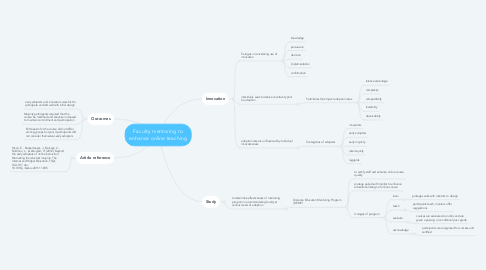
1. Outcomes
1.1. early adopters and innovators were first to participate and did well with initial design
1.2. Majority participants required that the course be modified and structure increased to maintain commitment and participation
1.3. Enthusiasm for the course did not differ among groups but year 4 participants did not consider themselves early adopters
2. Article reference
2.1. Hixon, E., Buckenmeyer, J., Barczyk, C., Feldman, L., & Zamojski, H. (2012). Beyond the early adopters of online instruction: Motivating the reluctant majority. The Internet and Higher Education, 15(2), 102–107. doi: 10.1016/j.iheduc.2011.11.005
3. Innovation
3.1. 5 stages in considering use of innovation
3.1.1. knowledge
3.1.2. persuasion
3.1.3. decision
3.1.4. implementation
3.1.5. confirmation
3.2. individuals seek to reduce uncertainty prior to adoption
3.2.1. 5 attributes that impact adoption rates
3.2.1.1. relative advantage
3.2.1.2. complexity
3.2.1.3. compatability
3.2.1.4. trialability
3.2.1.5. observability
3.3. adoption rate also influenced by individual innovativeness
3.3.1. 5 categories of adopters
3.3.1.1. innovators
3.3.1.2. early adopters
3.3.1.3. early majority
3.3.1.4. late majority
3.3.1.5. laggards
4. Study
4.1. to determine effectiveness of mentoring program in accommodating faculty at various levels of adoption
4.1.1. Distance Education Mentoring Program (DEMP)
4.1.1.1. to certify staff and enhance online course quality
4.1.1.2. protege paired with mentor to enhance educational design of online course
4.1.1.3. 4 stages of program
4.1.1.3.1. learn
4.1.1.3.2. teach
4.1.1.3.3. evaluate
4.1.1.3.4. acknowledge