

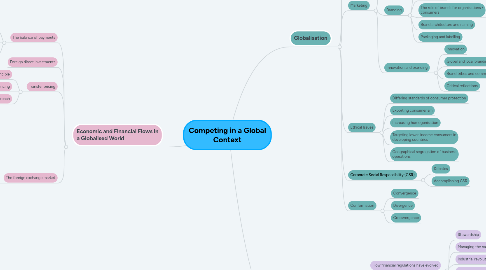
1. Economic and Financial Flows in a Globalised World
1.1. The balance of payments
1.1.1. Current account
1.1.2. Capital account
1.1.3. Financial account
1.2. Foreign direct investments
1.3. Transfer pricing
1.3.1. The arm's length principle
1.3.2. Transfer mispricing
1.3.3. Unitary taxation approach
1.4. The foreign exchange market
1.4.1. Supply of pounds to foreign currency market
1.4.2. Reaching equilibrium in the currency markets
1.4.3. Shifts in demand for a currency
1.4.4. Shifts in supply of the currency to the foreign currency market
1.4.5. Changes in supply and demand for a currency
1.4.6. Why changes to an exchange rate matter
1.4.7. The McBurger Index, The Economist Magazine [8]
1.4.8. Overcoming problems
1.4.9. The impact of an exchange rate
1.4.10. Government intervention
2. Globalisation
2.1. Glocalisation
2.1.1. Cultural cannibalism
2.1.2. Global players
2.2. Competing in a global trade environment
2.2.1. Understanding the global trade environment
2.2.2. Competition and trade among countries
2.2.2.1. The Diamond Model, Porter 1990 [3]
2.2.3. Competition among business organisations
2.2.3.1. The Five Forces Model, Porter 1980 [1]
2.3. Marketing
2.3.1. International marketing
2.3.1.1. Triggers for International expansion
2.3.1.2. Evaluation of the macro / micro environment
2.3.1.3. Entering and operating in international markets
2.3.1.4. Globalisation versus customisation
2.3.2. Branding
2.3.2.1. Defining a brand
2.3.2.2. Key Concepts
2.3.2.3. The role of brands for organisations / consumers
2.3.2.4. Brand architecture and naming
2.3.2.5. Packaging and labelling
2.3.3. Innovation and branding
2.3.3.1. Innovation
2.3.3.2. Global and local branding
2.3.3.3. Brand tribes and communities
2.3.3.4. Critical reflections
2.4. Ethical Issues
2.4.1. Differing standards of consumer protection
2.4.2. Exporting consumerism
2.4.3. Increasing homogenisation
2.4.4. Targeting lower-income consumers in developing countries
2.4.5. Geographical segregation of business operations
2.5. Corporate Social Responsibility (CSR)
2.5.1. Debates
2.5.2. Accomplishing CSR
2.6. Conformation
2.6.1. Convergence
2.6.2. Divergence
2.6.3. Crossvergence
3. Financial Regulations
3.1. How financial regulations have evolved
3.1.1. Stewardship
3.1.2. Managing the national economy
3.1.3. Industrial revolution and large investments
3.1.4. Borrowed legislation
3.1.5. Imperialism
3.1.6. Taxation
3.2. Different rules for different jurisdictions
3.2.1. Objectives of financial reporting
3.2.2. Contingent Model, Haller and Walton 2003 [6]
3.2.3. Regulations
3.2.4. 'Events, dear boy, events', Macmillan [7]
3.3. IFRS and IASB standards
3.3.1. Visions
3.3.2. Process for development of standards
3.3.3. Why we should adopt them
3.3.4. IFRS standards
3.3.5. IASB standards