

1. High and low context culture
1.1. Low context
1.1.1. high individualism
1.1.1.1. explicit manner
1.1.1.2. focused on requirements
1.1.1.3. precise
1.1.1.4. punctuality
1.2. high context
1.2.1. collectivism
1.2.1.1. implicit manner
1.2.1.2. relaxed about time
1.2.1.3. high commitment to long term relationships
2. Aspects to take into consideration
2.1. Culture involved
2.2. Age and sex of speakers
2.3. social class and occupations
2.4. roles and status in the interaction
3. Intercultural faileurs
3.1. Sociopragmatic
3.1.1. Inadequate knowledge of culture and social values.
3.2. Pragmalinguistic
3.2.1. misunderstanding of the intended illocutionary force of an utterance.
4. Apologies
4.1. Indirect
4.1.1. Does not include performative verb or IFID
4.2. Direct
4.2.1. includes Explicit illocutionary force indicating devices.
5. Ting-Toorney (1999)
5.1. It takes place when individuals influenced by different cultures negotiate shared meanings in interaction.
5.2. It depends on what one considers a culture.
5.3. Grammar and vocabulary
5.4. language pragmatics
5.4.1. Sensitive to nonverbal communication patterns.
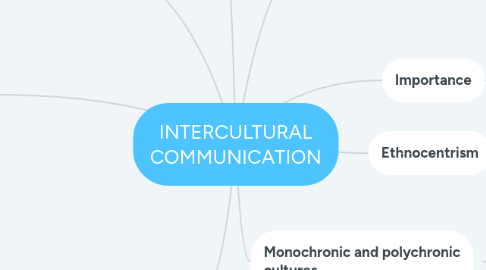
6. Importance
6.1. In some cultures it might be wrong what in others is not.
7. Ethnocentrism
7.1. we tend to think our culture is better than others.
8. Monochronic and polychronic cultures
8.1. The way that time is seen and used in every culture.
8.1.1. Monochronic
8.1.1.1. Time is very important for them. They are punctual and have a schedule.
8.1.2. Polychronic
8.1.2.1. Time is not a relevant topic. Their lives are not scheduled and they live as life happens.