LDES-501 Session 5: How We Design for Learning
저자: Leqi Li
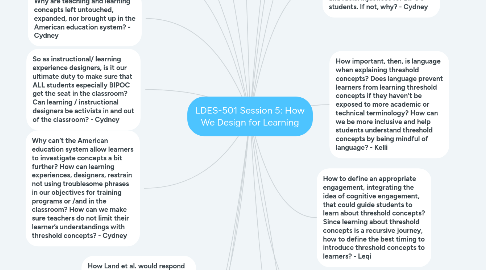
1. Has there been an attempt to overcome threshold concepts with learning communities? - Matthew
2. Does learning/instructional design have a semantic problem that can be overcome? - Matthew
3. Why are teaching and learning concepts left untouched, expanded, nor brought up in the American education system? - Cydney
4. If these structures(i.e., lecturing, assigned teamwork, creating a syllabus, etc.) are not teaching what is teaching, what are physical and visual examples of true teaching? - Cydney
5. So as instructional/ learning experience designers, is it our ultimate duty to make sure that ALL students especially BIPOC get the seat in the classroom? Can learning / instructional designers be activists in and out of the classroom? - Cydney
6. Why can’t the American education system allow learners to investigate concepts a bit further? How can learning experiences, designers, restrain not using troublesome phrases in our objectives for training programs or /and in the classroom? How can we make sure teachers do not limit their learner’s understandings with threshold concepts? - Cydney
7. How Land et al. would respond to such strategies(like providing early opportunities for success). Would they applaud McGuire’s work, or would they approach her strategies with caution? (Would an early opportunity for success be an unintended consequence of “good pedagogy”? ) Can one recommend good teaching/ learning practices without placing the caveats of TCs- Jimson
8. Do we care about student retention for the improvement of learning or for the sake of the university’s image? What do we mean by student engagement? How do we measure it meaningfully?- Jimson
9. If professors, and administrators are not able to see the variety of gifts that IDs bring to higher education, what are the underlying misconceptions/ silos that prevent them from seeing these? What might be the barriers for IDs from examining their own conceptions of the field? - Jimson
10. How might learning designers identify threshold concepts that are truly foundational and introduce them earlier in one's learning experience? And how is recognizing and supporting students' understanding of threshold concepts important to educational equity? - Kelli
11. Whether the threshold concept can be unified as one concept that would be introduced by teachers? How threshold knowledge can be effectively acquired by students - Leqi
12. How do we measure understanding of these big picture ideas? Can this be measured? - Matthew
13. What would a class focused on big threshold concepts look like? - Matthew
14. Are historically white institutions ready to seek the truth on how their institutions are anti-black, white supremacists, patriotic policies have shaped systemic and racial injustices for BIPOC students. If not, why? - Cydney
15. The difference between troublesome knowledge and threshold concept - Jimson; How to distinguish from core concepts and threshold concepts? - Leqi
16. How important, then, is language when explaining threshold concepts? Does language prevent learners from learning threshold concepts if they haven't be exposed to more academic or technical terminology? How can we be more inclusive and help students understand threshold concepts by being mindful of language? - Kelli
17. How to define an appropriate engagement, integrating the idea of cognitive engagement, that could guide students to learn about threshold concepts? Since learning about threshold concepts is a recursive journey, how to define the best timing to introduce threshold concepts to learners? - Leqi
18. What are the threshold concepts and the core concepts in the learning design field and how to apply for it? - Leqi
19. Morris also explains that “Instructional designers shouldn’t have to face a scarcity of resources...The work that offices of Digital Learning do is rarely given the support required.” He seems to be arguing for recognition on multiple levels. I’m wondering: Did peers find him convincing? Comforting as we acquire skills in this space? Are these views commonly held in the ID community? How might other ID respond to these claims, concerns? - William


