


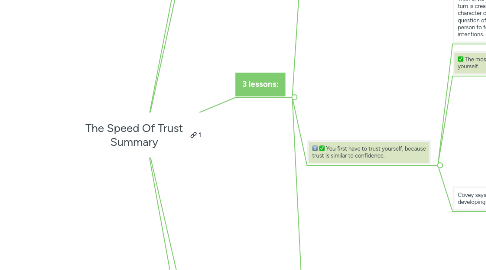
1. 1-Sentence-Summary:
1.1. The Speed Of Trust not only explains the economics of trust, but also shows you how to cultivate great trust in yourself, your relationships, and the three kinds of stakeholders you’ll deal with when you’re running a company.
2. Favorite quote from the author:
2.1. "We judge ourselves by our intentions and others by their behavior." - Stephen M. R. Covey
3. 3 lessons:
3.1. Trust increases speed and thus lowers costs in businesses.
3.1.1. A lot of people, trust in FedEx to deliver over night. And they do.
3.1.2. But did you know that your trust in them is actually a major part of why they’re so fast in the first place?
3.1.2.1. Since many people trust in FedEx to deliver the next day, FedEx gets hundreds of thousands of packages and orders to deliver each day – people buy, and they buy fast.
3.1.2.2. The speed with which FedEx receives incoming orders at scale is what endows it with the flow of financial capital it needs to not only pay for overnight drivers or book special air freight services, but also create and employ systems that will lower the average cost per delivery.
3.1.3. Vice versa, after 9/11 the average airport security check took an hour and a half, as opposed to 30 minutes before.
3.1.3.1. The trust in airplane passengers was gone, making the whole process of scanning them slower, leading to increased costs for personnel and machinery.
3.1.4. Covey says this adds a component of trust to the strategy vs. execution formula, which can either be a trust tax, or a tax dividend.
3.1.5. More trust leads to faster results, less trust to slower progress.
3.2. You first have to trust yourself, because trust is similar to confidence.
3.2.1. Trust is very much like confidence, which in turn is created when competence and character come together. It asks the question of how much you believe in a person to follow through on their intentions.
3.2.2. The most important person to trust then, is yourself.
3.2.2.1. Because when you don’t believe that you’ll do what you say you will, how can you possibly bestow that trust on others?
3.2.3. Covey says there are four cores to developing great trust in yourself.
3.2.3.1. Integrity
3.2.3.1.1. Integrity is about being honest whenever you get a chance.
3.2.3.1.2. Making even the smallest commitment and keeping it will also help – it might be as simple as stopping to hit the snooze button.
3.2.3.2. Intent
3.2.3.2.1. Intent comes from questioning your motives and developing admirable ones.
3.2.3.2.2. Forget “I wanna be rich” as a mantra, shoot for work that’s meaningful and you’ll be much better off.
3.2.3.3. Capabilities
3.2.3.3.1. Capabilities is all about developing skills, even when you don’t have to.
3.2.3.3.2. Deliberate practice will eventually make you good at what you do and you can draw confidence and trust from that.
3.2.3.4. Results
3.2.3.4.1. Results is then all about building a track record that you can look back upon as a confirmation of the trust you put in yourself
3.3. Societal trust is especially important for businesses to cultivate by contributing.
3.3.1. Covey says there are 3 kinds of stakeholders, with which your business must build trust in different ways.
3.3.1.1. The most striking one is the societal trust you build with stakeholders who are neither employees nor customers, but just part of your company’s environment.
3.3.2. Giving back to those around you will earn you the respect and admiration of society, which you might desperately need one day.
3.3.2.1. An example:
3.3.3. This is the kind of marketing you can’t manufacture, the kind that’s not even marketing. It’s trust.