


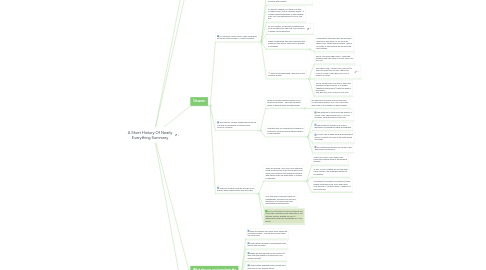
1. 1-Sentence-Summary:
1.1. A Short History Of Nearly Everything explains everything we’ve learned about our world and the universe so far, including how they formed, how we learned to make sense of time, space and gravity, why it’s such a miracle that we’re alive and how much of our planet is still a complete mystery to us.
2. Favorite quote from the author:
2.1. "If you were to pick yourself apart with tweezers, one atom at a time, you would produce a mound of fine atomic dust, none of which had ever been alive but all of which had once been you." - Bill Bryson
3. 3 lessons:
3.1. All it took to create most of the universe as we know it was a single, 3-minute moment.
3.1.1. A singularity is defined as a moment in which nothing is defined and everything is unpredictable. It’s a massive inflection point.
3.1.2. When scientists talk about the “initial” singularity, they refer to the moment the universe was created.
3.1.3. It’s hard to imagine, but think of a little, compact point, that is infinitely dense – it contains everything that’s in the universe now, but is compressed into a tiny, tiny dot.
3.1.4. All of a sudden, it explodes, splattering all of its contents into the void. This moment is known as the big bang.
3.1.5. When it happened, the entire universe was created in the time it takes you to prepare a sandwich.
3.1.5.1. Immediately after the blow, the universe doubled in size every 10-34 seconds – that’s FAST. Within three minutes, 98% of all matter in the universe we know today was created.
3.1.6. With all this expanding, how wide is the universe today?
3.1.6.1. About 100 billion light years – that’s the distance light can travel in a year times 100 BILLION.
3.1.6.2. And light is fast. It travels 300,000 km (or 186,000 miles) per second. That’s this much in a year: 9,460,800,000,000 or about 9.5 trillion.
3.1.6.3. So 9.5 trillion times 100 billion, that’s the diameter of the universe. In numbers (whatever that means), that’s the span in kilometers: 946,800,000,000,000,000,000,000.
3.2. The odds of a planet supporting life are so low that our presence on earth comes close to a miracle.
3.2.1. 99.5% of earth’s habitable space is not suited for humans – because it’s either water or doesn’t have enough oxygen.
3.2.1.1. We need land to move and live and even on land we’re limited: only 12% of the total land mass of our planet can host humans.
3.2.2. It’s pretty rare for a planet to be livable on in general, because several things have to come together:
3.2.2.1. The distance to a star must be perfect. If it’s too close, the surface burns, if it’s too far away, the planet will be iced over.
3.2.2.2. The planet has to keep out cosmic radiation by building the right atmosphere.
3.2.2.3. A moon has to keep the planet’s gravity in check, so that it can spin at the right speed and angle.
3.2.2.4. All of these events have to line up in the right order and timeline.
3.3. There’s a lot that could go wrong for our planet, which makes every new day a gift.
3.3.1. There are around 1,000,000,000 asteroids flying around space close to the earth, and about 10% of them that regularly intersect with earth’s orbit are larger than 10 meters in diameter.
3.3.1.1. That’s 100 million 10m-sized rocks potentially hitting earth at tremendous speeds!
3.3.1.2. In fact, 2,000 of those are so large that upon collision, we might get wiped out completely.
3.3.1.3. According to scientists calculations, those deadly asteroids could fly by and nearly miss around 2-3 times a week – without us even noticing.
3.3.2. As if that wasn’t enough, there are earthquakes, tornados and volcano eruptions, all of which can have devastating consequences.
3.3.3. So no, it’s totally not normal that the sun rises every morning. Every single day is yet another miracle, waiting for you to appreciate it and take advantage of it. Live like it!