


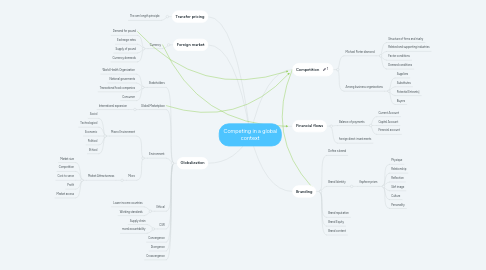
1. Transfer pricing
1.1. The arm length principle
2. Foreign market
2.1. Currency
2.1.1. Demand for pound
2.1.2. Exchange rates
2.1.3. Supply of pound
2.1.4. Currency demands
3. Globalization
3.1. Stakeholders
3.1.1. World Health Organization
3.1.2. National goverments
3.1.3. Transational food companies
3.1.4. Consumer
3.2. Global Marketplace
3.2.1. International expansion
3.3. Environment
3.3.1. Macro Environment
3.3.1.1. Social
3.3.1.2. Technological
3.3.1.3. Economic
3.3.1.4. Political
3.3.1.5. Ethical
3.3.2. Micro
3.3.2.1. Market Attractveness
3.3.2.1.1. Market size
3.3.2.1.2. Competition
3.3.2.1.3. Cost to serve
3.3.2.1.4. Profit
3.3.2.1.5. Market access
3.4. Ethical
3.4.1. Lower income countries
3.4.2. Working standards
3.5. CSR
3.5.1. Supply chain
3.5.2. moral acountability
3.6. Convergence
3.7. Divergence
3.8. Crossvergence
4. Competition
4.1. Michael Porter diamond
4.1.1. Structure of firms and rivalry
4.1.2. Related and supporting industries
4.1.3. Factor conditions
4.1.4. Demand conditions
4.2. Among business organisations
4.2.1. Suppliers
4.2.2. Substitutes
4.2.3. Potential Entrants]
4.2.4. Buyers
5. Financial flows
5.1. Balance of payments
5.1.1. Current Account
5.1.2. Capital Account
5.1.3. Financial account
5.2. foreign direct investments
6. Branding
6.1. Define a brand
6.2. Brand Identity
6.2.1. Kapferer prism
6.2.1.1. Physique
6.2.1.2. Relationship
6.2.1.3. Reflection
6.2.1.4. Slef image
6.2.1.5. Culture
6.2.1.6. Personality