

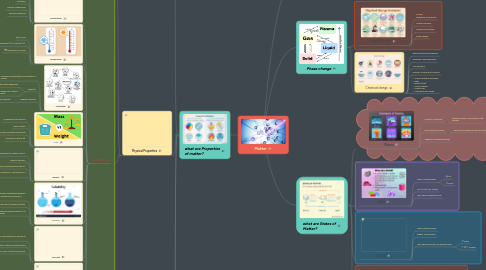
1. what are Properties of matter?
1.1. Chemical Properties
1.1.1. Describe
1.1.1.1. Reactivity
1.1.1.1.1. how easy and fast chemical reaction
1.1.1.1.2. quickly and easily =Reactive
1.1.1.1.3. not quickly and easily= inert
1.1.1.2. Corrosion (Oxidation and Tarnish)
1.1.1.2.1. Oxidation
1.1.1.2.2. Tarnish
1.1.1.3. Toxicity
1.1.1.3.1. degree level
1.1.1.3.2. toxic
1.1.1.4. Flammability
1.1.1.4.1. ignite or catch fire
1.1.1.5. Radioactivity
1.1.1.5.1. Radioactive atoms- radioactive matter
1.1.1.6. pH
1.1.1.6.1. measurement of acidic
1.1.1.6.2. – pH (0 to 6) -acidic. – pH (8 to 14) - basic. – pH of 7- neutral.
1.1.1.7. Combustibility
1.1.1.7.1. burns.
1.2. Physical Properties
1.2.1. Qualitative
1.2.1.1. Descriptive
1.2.1.1.1. –Color
1.2.1.1.2. -Odor
1.2.1.1.3. -Taste
1.2.1.1.4. -Sound
1.2.1.1.5. -Hardness
1.2.1.1.6. -Texture
1.2.1.1.7. -Flexibility
1.2.2. Quantitative
1.2.2.1. Conductivity
1.2.2.1.1. conductors
1.2.2.1.2. conduction.
1.2.2.1.3. insulators
1.2.2.1.4. Thermal conductivity
1.2.2.1.5. Electrical resistivity
1.2.2.2. Temperature
1.2.2.2.1. hot or cold
1.2.2.2.2. Fahrenheit (°F) or Celsius (°C).
1.2.2.2.3. temperature= energy
1.2.2.3. Magnetism
1.2.2.3.1. invisible force exerted by some types of matter
1.2.2.3.2. magnets
1.2.2.3.3. magnetic objects
1.2.2.4. Mass
1.2.2.4.1. A measure of the amount
1.2.2.4.2. type of atoms
1.2.2.4.3. How closely the atoms are packed
1.2.2.4.4. measured in grams (g).
1.2.2.5. Density
1.2.2.5.1. measurement of usage of space .
1.2.2.5.2. objects /volume=
1.2.2.5.3. measured in grams/milliliter (g/mL).
1.2.2.5.4. mass+size+arrangement= the density of a substance
1.2.2.6. Solubility
1.2.2.6.1. describes how well a substance dissolves into another substance to produce a solution
1.2.2.6.2. measured is grams per 100 grams of water.
1.2.2.6.3. high solubility will dissolve more in 100 grams of water
1.2.2.7. Viscosity
1.2.2.7.1. a measure of the resistance of a fluid to flow.
1.2.2.7.2. high viscosity is “thick” and flows slowly
1.2.2.7.3. low viscosity is “thin” and will flow quickly
1.2.2.8. Boiling Point
1.2.2.8.1. the temperature at which a liquid evaporates
1.2.2.8.2. gas changes into a liquid when gas is cooled
1.2.2.9. Melting Point
1.2.2.9.1. the temperature at which a solid melts to liquid
1.2.2.9.2. A liquid changes into a solid when a liquid is cooled
1.3. Intensive properties
1.4. Extensive properties
2. What is matter made of?
2.1. Tiny particles
2.1.1. too small to be seen
2.1.2. Called Atoms
2.1.2.1. Basic building blocks
2.1.2.2. Different /combinations of atoms
2.2. Positively charged atoms
3. Phase change
3.1. Physical change
3.1.1. no new substance is produced.
3.1.2. usually reversible
3.1.3. change size or shape
3.1.4. phase change
3.2. Chemical change
3.2.1. physical/chemical properties
3.2.2. produces a new substance.
3.2.3. not reversible
3.2.4. burning, cooking and corrosion
3.2.5. – A new substance produced – Light – Bubbles (gas) – A color change – A new smell – A temperature change
4. what are States of Matter?
4.1. Plasma
4.1.1. Common in universe
4.1.1.1. Between planets, solar systems and galaxies
4.1.2. Not common on Earth
4.1.2.1. Can be found both naturally and manmade.
4.1.2.1.1. Bright light of lightning
4.1.2.1.2. Glowing light
4.1.3. Negatively charged electrons
4.2. Solid
4.2.1. Atoms packed tightly
4.2.1.1. Ice
4.2.1.2. Pencil
4.2.2. Can't move/ can vibrate
4.2.3. Have definite shape/volume
4.3. Liquid
4.3.1. Atoms packed loosely
4.3.2. Slightly move around.
4.3.3. Have definite volume /no definite shape
4.3.3.1. Water
4.3.3.2. Alcohol
4.4. Gas
4.4.1. Packed very loosely
4.4.2. Constantly move around
4.4.3. No definite volume/ shapes
4.4.3.1. Water Vapor
4.4.3.2. Oxygen