Consequences of Climate Change
저자: dakshesh das
1. Rising sea Levels
1.1. Problem - Water expands as it heats. At the same time, global warming promotes the melting of polar ice sheets and glaciers. Because of the combination of these changes, sea levels are rising, resulting in flooding and erosion of coastal and low-lying communities.
1.2. Rising sea levels Solution - Building seawalls is one method that communities use to reduce floods caused by tides and storms. These barriers are typically erected five to six feet above sea level and cost between $600 and $2,000 per foot. Advantage - Armoring is the most traditional flood-protection method. It's well-known, acts reliably, and may be used in tandem with other measures to safeguard existing development from rising water. It may be used to protect against storm surge as well as baseline sea level rise. It can also be engineered to allow for additional construction, like as homes along super levees, or to conserve endangered environment, such as sand dunes. Disadvantage -It's only a temporary fix. All coastal armoring can only be designed to withstand a specific storm magnitude or rise in sea level. It also needs pricey annual maintenance and ongoing monitoring to assure its safety. It may possibly burst as a result of an abnormally big storm event.
2. Spread of Pests and Diseases
2.1. Problem - Warmer temperatures reduce the efficacy of certain insecticides while favouring insect carriers of many disease pathogens and natural foes of pests and illnesses. Thus, depending on the pest or disease, greater CO2 may operate synergistically or antagonistically with higher temperatures. The outcomes of such interactions are difficult to predict. As a result, one must wait for outward indicators of the presence of a pest or illness before taking action. Elevated CO2 levels and higher temperatures will continue to alter the composition and duration of pest and disease infective phases. A rise in temperature and precipitation levels promotes the growth and dissemination of most pest species by providing a warm and humid habitat as well as the moisture required for their growth. Climate change, combined with increased global commerce, is one factor fueling the spread of pests and illnesses. Climate change can have an impact on pest population size, survival rate, and geographical spread, as well as disease intensity, development, and geographical dispersion. Temperature and rainfall are major contributors to changes in how and where pests and illnesses spread. Temperatures and precipitation levels that are too high, on the other hand, can impede the growth and reproduction of some pest species and even kill them by washing their eggs and larvae off the host plant.
2.2. Solution - Natural Pesticides Crops are prone to being attacked, damaged, and competed with. Insects, plant disease, nematodes, rodents, weeds, and air pollution are just a few of the numerous adversaries that can diminish agricultural yields and prevent man from harvesting part of his farm-stored harvests. Insecticides are typically effective, inexpensive, and safe if used appropriately; nevertheless, the benefits they provide might be countered in part by negative side effects. Some pesticides are effective even in trace doses. This fact has prompted the creation of ultralow-volume technology, in which specific equipment allows the dispersal of small amounts of undiluted chemicals, resulting in economic savings as well as a significant decrease of chemicals in the environment. For many years, researchers have been testing light traps that emit radiation that attracts insects. Certain cultural techniques can help to avoid or lessen crop damage caused by insects. These include agricultural residue destruction, deep ploughing, crop rotation, fertiliser application, strip-cropping, irrigation, and planned planting activities. Such techniques are beneficial, but they cannot be depended on to completely remove severe infestations.
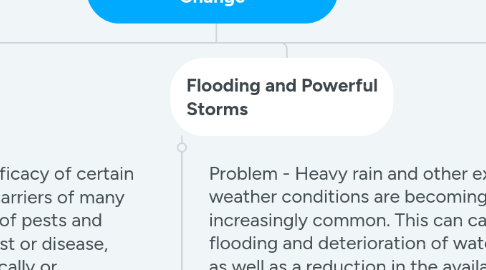
3. Flooding and Powerful Storms
3.1. Problem - Heavy rain and other extreme weather conditions are becoming increasingly common. This can cause flooding and deterioration of water quality, as well as a reduction in the availability of water resources in some areas. As climate change warms up the environment, the air can carry 7 percent more water vapour for every one-degree Celsius rise in temperature. When this air rapidly cools, water vapour condenses into droplets, which combine to make heavy rain.
3.2. Solution - Natural Flood Management - Natural flood management entails taking tiny steps to slow the flow of water before it reaches larger rivers. Small obstacles in ditches and fields, or notches carved into embankments, might be used to channel water onto open ground. When pools form outside a river's main channel, the water is momentarily diverted from the main flow, diminishing the force of the floodwaters. Drainage - Sustainable drainage is frequently employed in towns and cities that are prone to flash floods after heavy rain. Large amounts of terrain in cities are covered with concrete and tarmac. Rain is sent directly into drainage systems, which might become overburdened. Dams - Dams prevent flooding by collecting and storing water when it reaches a specific level. This implies that if there is no extra water, the river will continue to flow naturally. When water levels rise, the dam restricts the flow of water through the opening to prevent floods.
4. Loss of Habitat
4.1. Problem - Climate change is occurring at such a rapid pace that many plant and animal species are failing to adapt. Many terrestrial, freshwater, and marine species have already relocated. If global average temperatures continue to rise unabated, some plant and animal species will face an increased danger of extinction. The Earth's crust is shifting as climate change wreaks havoc on ice sheets and glaciers throughout the planet. The ongoing melting of Greenland and Antarctica's ice sheets is forcing the planet's crust to bend as water is redistributed to the global seas, resulting in increasing sea levels. The movement is caused by the abrupt loss of surface weight as enormous pieces of ice melt, causing a vertical and horizontal movement. While scientists have examined the vertical reaction to changes as land lifts up, this is the first time that the horizontal movement has been monitored.
4.2. Solution - We can counteract habitat loss by maintaining natural resources and learning how to use them in ways that do not necessitate such frequent habitat damage. As rapidly as people may destroy natural environments, we should be equally eager to repair and seek to replace what has been lost. We can help support the building of areas that will serve as a sanctuary for displaced species instead of saving habitats that cannot be protected. We should also educate people on the value of biodiversity. Comprehensive environmental education helps people realise the importance of biodiversity and offers ways for everyone to contribute to causes that help preserve many diverse species alive.
5. Food Insecurity
5.1. Problem - The economic factors of food insecurity are exacerbated by climate change. Variation in crop growing season duration and increased frequency of severe events as a result of climate change, as well as the resulting increase in yield, have a negative impact on farmers' net income. India is especially susceptible since its rural areas are home to tiny and marginal farmers who rely on rain-fed monocropping, which only supplies a few months of food security in a typical year. Given their fragility, children would be disproportionately affected by increasing frequency of droughts and floods in places with severe food poverty and inequality. Because impoverished households often spend the majority of their wages on food, a significant drop in income is likely to have a significant impact on child nutrition.
5.2. Solution - Food is wasted mostly as a result of improper preparation, rough or lousy routes, picky clients, and insufficient storage facilities. If storage facilities are upgraded and sufficient preparations for how the food will be utilised are made, less food will be wasted, and the community will be more food secure. Enhance Current Infrastructure Programs - Some farmers are unable to get their goods to market due to inadequate infrastructure, which includes roads, storage facilities, and food processing equipment. It rots on farms rather of being distributed to people in need or processed. More food will be available in the market if infrastructure is upgraded, and food insecurity levels may decrease. Lower the Risk of Commercialization Food insecurity will decrease if food is raised with the aim of feeding the community or country. Farmers may grow more food crops and cash crops when there is a sufficient supply of food crops on the market.


