


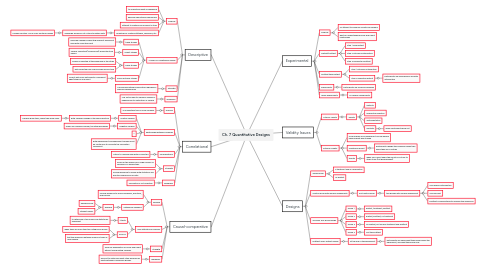
1. Descriptive
1.1. Purpose
1.1.1. to understand what is happening
1.1.2. describe educational phenomena
1.1.3. Attempt to capture one moment in time
1.1.4. Longitudinal: Capture attitudes, behaviors, etc.
1.1.4.1. Challenge: Require a lot of time to gather data
1.1.4.1.1. Possible solution: Use a cross-sectional design
1.2. 4 Types of Longitudinal Design
1.2.1. trend studies
1.2.1.1. Describe change by selecting different samples at each data collection point
1.2.2. cohort studies
1.2.2.1. sample: consistent (same group) during the time period
1.2.3. panel studies
1.2.3.1. sample is selected at the beginning of the study
1.2.3.2. data collected from same sample across time
1.2.4. cross-sectional studies
1.2.4.1. Collect data from participants of different ages/stages in one point
1.3. Strength
1.3.1. Can provide detailed information regarding a specific phenomenon
1.4. Weakness
1.4.1. May not be able to measure change of behaviordue to maturation of sample
2. Correlational
2.1. Purpose
2.1.1. To understand two or more variables
2.2. Relationship between variables
2.2.1. Positive variable
2.2.1.1. Both variables change in the same direction
2.2.1.1.1. Children grow taller, when they grow older.
2.2.2. Negative variable
2.2.2.1. When one variable increase, the other decreases
2.2.3. r
2.2.4. Both independent and dependent variable must be continuous to calculate the correlation coefficient
2.3. Considerations
2.3.1. critical to consider how data is collected
2.4. Strength
2.4.1. Allow for the analysis of a large number of variables in a single study
2.4.2. Provide evidence to assess both statistical and practical significance of data
2.5. Weakness
2.5.1. Correlation is not causation
3. Causal-comparative
3.1. Purpose
3.1.1. Provide evidence to inform programs, practices, and policies
3.1.2. Categorical variables
3.1.2.1. Example
3.1.2.1.1. Residence hall
3.1.2.1.2. Student majors
3.2. Uses statistics for analysis
3.2.1. t-tests
3.2.1.1. to determine if two means are statistically significant
3.2.2. ANOVA
3.2.2.1. when there are more than two categorical groups
3.2.2.2. test the difference between means of three or more groups
3.3. Strength
3.3.1. Allow for examination of cause and effect without manipulating variables
3.4. Weakness
3.4.1. Difficult to determine what other differences exists between comparison groups
4. Experimental
4.1. Purpose
4.1.1. To attempt to influence a particular variable
4.1.2. Best for understanding cause and effect relationship
4.2. Pretest/Posttest
4.2.1. Step 1 Give pretest
4.2.2. Step 2 Introduce intervention
4.2.3. Step 3 Administer posttest
4.3. Posttest then pretest
4.3.1. Step 1 Introduce intervention
4.3.2. Step 2 Reflective pretest
4.3.2.1. participants are asked before and after intervention
4.4. Experiments
4.4.1. participants are randomly assigned
4.5. Quasi-experiments
4.5.1. no random assignments
5. Validity Issues
5.1. Internal Validity
5.1.1. Threats
5.1.1.1. Maturity
5.1.1.2. Differential selection
5.1.1.3. Instrumentation
5.1.1.4. Mortality
5.1.1.4.1. When participants drop out
5.2. External Validity
5.2.1. How findings of an experiment can be applied beyond what was studied
5.2.2. Hawthorne Effect
5.2.2.1. participants change their behavior when they know they are in a study
5.2.3. threats
5.2.3.1. when you cannot apply the results of a study to other study (not generalizable)
6. Designs
6.1. Single-group
6.1.1. a treatment and an observation
6.1.2. no pretest
6.2. Control group with random assignments
6.2.1. first control group
6.2.1.1. two groups with random assignment
6.2.1.1.1. one receives intervention
6.2.1.1.2. one does not
6.2.1.1.3. posttest is administered to examine the difference
6.3. Solomon four group design
6.3.1. Group 1
6.3.1.1. pretest, treatment, posttest
6.3.2. Group 2
6.3.2.1. pretest, posttest, no treatment
6.3.3. Group 3
6.3.3.1. No pretest, but receive treatment and posttest
6.3.4. Group 4
6.3.4.1. just the posttest
6.4. Posttest-Then-Pretest Design
6.4.1. At the end of the experiment
6.4.1.1. participants are asked what they knew before the experiment, and what they know now