


1. CCBs
1.1. DHP
1.1.1. Inhibit Ca ions from entering vascular smooth muscle & myocardial cells causing peripheral aterial vasodilation (decreased SVR & BP)
1.1.1.1. **Amlodipine**
1.1.1.1.1. Safest if CCB needed to lower BP in HFrEF
1.1.1.2. **Nicardipine IV**
1.1.1.2.1. C/I in advanced aortic stenosis
1.1.1.3. **Nifedipine ER (Procardia XL) IR (Procardia)**
1.1.1.3.1. IR should not be used for chronic HTN or acute BP reduction in non-pregnant adults
1.1.1.3.2. ER drug of choice in pregnancy
1.1.1.4. **Clevidipine (injection)**
1.1.1.4.1. C/I in soy or egg allergy
1.1.1.4.2. Lipid emulsion requiring strict aseptic technique; max time after puncture is 12 hours
1.1.2. Warnings
1.1.2.1. Hypotension, worsening angina &/or MI, severe hepatic impairment
1.1.3. AEs
1.1.3.1. Peripheral edema, HA, flushing, palpitations, reflex tachy, gingival hyperplasia
1.2. Non-DHP
1.2.1. More selective for myocardium; decrease BP due to negative inotropic (decreased force of contraction) & negative chronotropic effects
1.2.1.1. **Diltiazem**
1.2.1.2. **Verapamil**
1.2.2. **C/I**
1.2.2.1. Hypotension (SBP < 90) or cardiogenic shock
1.2.3. Warnings
1.2.3.1. May worsen HF symptoms, bradycardia
1.2.4. AEs
1.2.4.1. Edema, constipation, gingival hyperplasia
1.3. DDI
1.3.1. CYP3A4 substrates
1.3.2. Non-DHP CCBs are substrates & inhibitors of P-gp & moderate inhibitors of 3A4 - lower dose of simvastatin or lovastatin
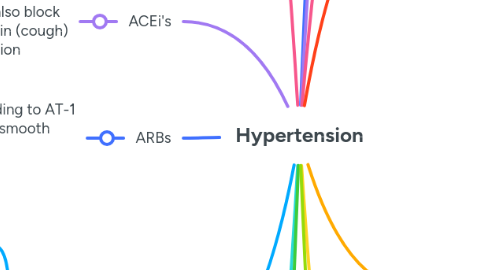
2. ACEi's
2.1. Decrease vasoconstriction & aldosterone secretion; also block degradation of bradykinin (cough) which leads to vasodilation
3. ARBs
3.1. Block AngII from binding to AT-1 receptor on vascular smooth muscle, preventing vasoconstriction
3.1.1. Less cough/angioedema compared to ACEi
4. K-Sparing Diuretics
4.1. **Triamterene & Amiloride**
4.1.1. Usually in combo with HCTZ to counteract K losses seen w/ thiazides
4.1.1.1. BW for hyperkalemia; more likely in DM, renal impairment, or elderly
4.2. Aldosterone antagonists
4.2.1. **Spironolactone**
4.2.1.1. Non-selective; also blocks androgen
4.2.1.1.1. C/I in Addison's disease; gynecomastia, breast tenderness, impotence
4.2.2. **Eplerenone**
4.2.2.1. Selective; does not exhibit endocrine side effects
4.2.2.1.1. Increases TGs
4.2.3. Compete with aldosterone at receptor sites in DCT & collecting ducts of nephron to increase Na & water excretion
5. Beta-blockers: block B-1 &/or B-2 adrenergic receptors, resulting in **decreased HR & contractility**
5.1. Use caution in DM > can worsen hyper or hypo & can mask hypo
5.2. Use caution in COPD/asthma, Raynaud's
5.2.1. Beta-1-selective preferred in COPD/asthma
5.2.1.1. AMEBBA: Atenolol, metoprolol, esmolol, bisoprolol, betaxolol, acebutolol
5.2.2. Avoid non-selective; can be used in portal HTN
5.2.2.1. **Propranolol, Nadolol, Carvedilol, Labetalol**
5.2.2.1.1. Car & Lab have A-1 blocking > decreased peripheral vasoconstriction > lower BP
5.2.2.1.2. Prop associated w/ more CNS side effects; can be useful in migraine prophylaxis > crosses BBB
5.2.2.2. **Nebivolol**
5.2.2.2.1. Nitric oxide-dependent vasodilation
5.3. BW: do not d/c abruptly, especially in CAD/IHD; taper
5.4. **Esmolol** C/I in pulmonary htn & w/ use of IV non-DHP CCBs
5.5. **Metoprolols** should be taken w/ or immediately following food
5.5.1. Tartrate IV is not equivalent to PO; IV:PO ratio is 1:2.5
6. Direct vasodilators
6.1. Direct vasodilation of arterioles w/ little effect on veins > decreased SVR
6.1.1. **Hydralazine**
6.1.1.1. Risk of DILE, hypotension
6.1.1.2. AE: peripheral edema, HA, flushing, palpitations, reflex tachy
6.1.2. **Minoxidil (Rogaine)**
6.1.2.1. Very potent antihypertensive; administer w/ BB & loop
7. Categories of BP
7.1. Normal: SBP < 120 **&** DBP < 80
7.2. Elevated: SBP 120-129 **&** DBP < 80
7.3. Stage I HTN: SBP 130-139 **or** DBP 80-89
7.4. Stage II HTN: SBP 140 or higher **or** DBP 90 or higher
8. Key drugs which increase BP
8.1. Amphetamines/ADHD
8.2. Cocaine
8.3. Decongestants
8.4. ESAs
8.5. Immunosuppressants
8.6. NSAIDs
8.7. Systemic steroids
9. When to start HTN tx
9.1. Stage II HTN
9.2. Stage I HTN **plus**
9.2.1. Clinical CVD
9.2.2. ASCVD 10% or higher
9.2.3. Doesn't meet BP goal after 6 mo of lifestyle mods
10. Initial drug selection
10.1. Non-black
10.1.1. thiazide, DHP CCV, ACE, or ARB
10.2. Black
10.2.1. thiazide or DHP CCB
10.3. CKD
10.3.1. ACE or ARB
10.4. DM w/ albuminuria
10.4.1. ACE or ARB
10.5. DM w/ CAD
10.5.1. ACE or ARB
11. Thiazides
11.1. Inhibit Na reabsorption in the DCT causing increased excretion of Na, Cl, H2O, & K
11.1.1. **Chlorthalidone**
11.1.1.1. Not effective in CrCl < 30 (except **metolazone**)
11.1.2. **HCTZ**
11.2. **C/I**
11.2.1. Hypersensitivity to sulfonamide-derived drugs
11.2.2. Anuria
11.3. AEs
11.3.1. Decreased K, Mg, Na
11.3.2. Increased Ca, UA, LDL, TG, BG
11.3.3. Photosensitivity
11.4. DDI
11.4.1. NSAIDs (cause Na & H2O retention)
11.4.1.1. Decrease effectiveness of antihypertensives
11.4.2. Thiazides decrease lithium renal conc. increasing lithium toxicity risk
11.4.3. Increase dofetilide conc. which increases QT prolonging risk
12. Alpha-2 **agonists**
12.1. Reduces sympathetic outflow of NE > decreases SVR & HR
12.1.1. **Clonidine**
12.1.1.1. Often used for resistant HTN & inability to swallow (patch)
12.1.1.1.1. Patch can cause rash, pruritis, erythema; applied weekly; remove before MRI
12.1.2. **Guanfacine IR**
12.1.2.1. ER used for ADHD
12.1.3. **Methyldopa**
12.1.3.1. C/I with MAOIs & active liver disease
12.1.3.2. Risk of DILE & hemolytic anemia
12.1.3.3. Drug of choice in **pregnancy**
12.2. Do not d/c abruptly > rebound HTN
12.2.1. Anticholinergic effects
13. Hypertensive Crises: 180/120 or higher
13.1. Urgency
13.1.1. No acute organ damage
13.1.1.1. Treat w/ oral med that has short onset of action
13.1.1.2. Decrease BP gradually over 24-48 hrs
13.2. Emergency
13.2.1. Acute organ damage
13.2.1.1. Treat w/ IV meds
13.2.1.1.1. Chlorothiazide, clevidipine, dilt, enaliprilat, esmolol, hydral, labetalol, met tart, nicardipine, nitro, nitroprusside, propranolol, verap
13.2.1.2. Decrease BP by no more than 25% within 1st hour, then if stable, decrease to 160/100 in next 2-6 hours