

e-Learning
저자: Nick Howson
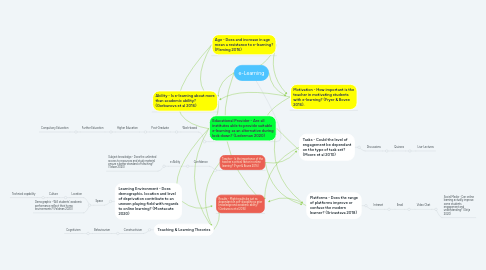
1. Educational Provider - Are all institutes able to provide suitable e-learning as an alternative during lock down? (Lederman 2020)
1.1. Work-based
1.1.1. Post-Graduate
1.1.1.1. Higher Education
1.1.1.1.1. Further Education
2. Age - Does and increase in age mean a resistance to e-learning? (Fleming 2016)
3. Ability - Is e-learning about more than academic ability? (Gorbunovs et al 2016)
4. Teaching & Learning Theories
4.1. Constructivism
4.1.1. Behaviourism
4.1.1.1. Cognitivism
5. Learning Environment - Does demographic, location and level of deprivation contribute to an uneven playing field with regards to online learning? (Montacute 2020)
5.1. Space
5.1.1. Location
5.1.1.1. Culture
5.1.1.1.1. Technical capability
5.1.2. Demographic - Will students' academic performance reflect their home environments? (Feldman 2020)
6. Results - Might results be just as dependant on self-discipline as prior knowledge and academic ability? (Gorbunovs et al 2016)
7. Teacher - Is the importance of the teacher a critical factor in online learning? (Fryer & Bovee 2016)
7.1. Confidence
7.1.1. e-Ability
7.1.1.1. Subject knowledge - Does the unlimited access to resources and study material ensure a better standard of teaching? (Talwar 2020)
8. Motivation - How important is the teacher in motivating students with e-learning? (Fryer & Bovee 2016).
9. Tasks - Could the level of engagement be dependant on the type of task set? (Moore et al 2010)
9.1. Discussions
9.1.1. Quizzes
9.1.1.1. Live-Lectures
10. Platforms - Does the range of platforms improve or confuse the modern learner? (Srivastava 2018)
10.1. Intranet
10.1.1. Email
10.1.1.1. Video Chat
10.1.1.1.1. Social Media - Can online learning actually improve some students engagement and understanding? (Girija 2020)