


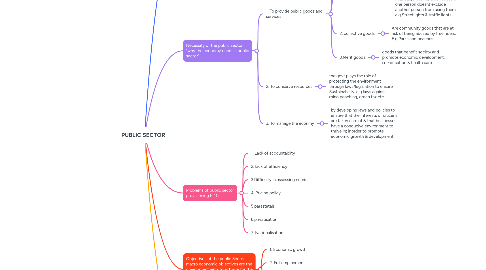
1. the part of the government that owns, produces public goods and services to its citizens
1.1. levels of governmeent
1.2. National Level: Legislative arm
1.3. Provincial level: e.g Gauteng government
1.4. Local level: Municipality i.e Ekurhuleni municipality
2. Necessity of the public sector: "why the economy needs a public sector"
2.1. 1. To provide public goods and services
2.1.1. types of public goods
2.1.2. 1. community goods:
2.1.2.1. are non- excludable - meaning anyone can use them whether or not they pay for them or not & they're also non rivalrous; meaning that the use of one person doesnt exclude another person from using them. e.g Streetlights & traffic lights
2.1.3. 2. collective goods
2.1.3.1. Are community goods that are at risk of being abused by free riders. E.g Parks and beaches
2.1.4. 3.Merit goods
2.1.4.1. goods that benefit socirty and promote economic development. i.e Education & health care
2.2. 2. To conserve resources
2.2.1. the govt plays the role of protecting the environment through laws/legislation to ensure Sustainability. e.g laws against rhino poaching, green tax etc.
2.3. 3. To manage the econmy
2.3.1. by developing laws and policies to ensure that the interests of citizens are taken care of & that businesses have a conducive environment to thrive in; inorder to promote economic growth & development.
3. Problems of public sector provisioning P.40
3.1. 1. Lack of accountablity
3.2. 2. lack of efficiency
3.3. 3.Difficulty in assessing needs.
3.4. 4. Pricing policy
3.5. 5.parastatals
3.6. 6.privatisation
3.7. 7. Nationalisation
4. Objectives of the public Sector: macro economic objectives are the government aims to achieve for the optimum functioning of the economy
4.1. 1. Economic growth
4.2. 2. Full employment
4.3. 3. Exchange rate stability
4.4. 4. Price stability
4.5. 5. Economic equity
5. Budget
5.1. 1. The main budget:
5.1.1. refers to a document that outlines anticipated state income & projected state expenditure for the year; it is a legal binding document