


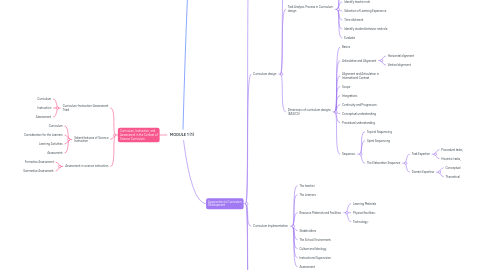
1. Curriculum, Instruction, and Assessment in the Context of Science Curriculum
1.1. Curriculum-Instruction-Assessment Triad
1.1.1. Curriculum
1.1.2. Instruction
1.1.3. Assessment
1.2. Salient features of Science Instruction
1.2.1. Curriculum
1.2.2. Consideration for the Learners
1.2.3. Learning Activities
1.2.4. Assessment
1.3. Assessment in science instruction
1.3.1. Formative Assessment
1.3.2. Summative Assessment
2. Concept of Curriculum
2.1. Definition of Curriculum
2.2. Types of Curricula
2.2.1. Formal Curriculum.
2.2.2. Informal Curriculum.
2.2.3. Actual Curriculum.
2.2.4. Core Curriculum
2.2.5. Extra-Mural Curriculum
2.2.6. Hidden/Collateral Curriculum.
2.3. Curriculum perspective
2.3.1. Rationalists says
2.3.2. Empiricists think
2.3.3. Pragmatists believe
2.3.4. Existentialists conclude
2.4. Elements of Curriculum
2.4.1. Purpose
2.4.2. Content
2.4.3. Methods
2.4.4. Evaluation
3. Approaches to Curriculum Development
3.1. Curriculum Planning
3.1.1. Learners psychological preparation
3.1.2. Learning Theory
3.1.3. Acquiring knowledge
3.1.4. Societal considerations
3.1.4.1. Political Factor
3.1.4.2. Social Factor
3.1.4.3. Economic Factor
3.1.4.4. Technological Factors
3.1.4.5. Environmental Factors
3.2. Curriculum design
3.2.1. Models of Curriculum Design
3.2.1.1. The Objectives Model
3.2.1.2. The Process Model
3.2.1.3. Tyler’s Model
3.2.1.4. Wheeler’s Model
3.2.1.5. Kerr’s Model
3.2.2. Task Analysis Process in Curriculum design
3.2.2.1. Establish general goals of education
3.2.2.1.1. Level of Goals
3.2.2.2. Selection of Content
3.2.2.3. Identify teacher role
3.2.2.4. Selection of Learning Experience
3.2.2.5. Time allotment
3.2.2.6. Identify student behavior and role.
3.2.2.7. Evaluate
3.2.3. Dimensions of curriculum designs (BASICS)
3.2.3.1. Basics
3.2.3.2. Articulation and Alignment
3.2.3.2.1. Horizontal alignment
3.2.3.2.2. Vertical alignment
3.2.3.3. Alignment and Articulation in International Context
3.2.3.4. Scope
3.2.3.5. Integrations
3.2.3.6. Continuity and Progression.
3.2.3.7. Conceptual understanding
3.2.3.8. Procedural understanding
3.2.3.9. Sequence.
3.2.3.9.1. Topical Sequencing
3.2.3.9.2. Spiral Sequencing
3.2.3.9.3. The Elaboration Sequence
3.3. Curriculum Implementation
3.3.1. The teacher
3.3.2. The Learners
3.3.3. Resource Materials and Facilities.
3.3.3.1. Learning Materials
3.3.3.2. Physical facilities:
3.3.3.3. Technology:
3.3.4. Stakeholders
3.3.5. The School Environment.
3.3.6. Culture and Ideology.
3.3.7. Instructional Supervision
3.3.8. Assessment
3.4. Curriculum Evaluation
3.4.1. Curriculum Evaluation Approaches
3.4.1.1. Bureaucratic
3.4.1.2. Autocratic
3.4.1.3. Democratic
3.4.1.4. Norm-Referenced
3.4.1.5. Criterion Referenced
3.4.2. Forms of Evaluation
3.4.2.1. Formative Evaluation
3.4.2.2. Summative Evaluation
3.4.3. Evaluation Methods and Tools
3.5. Curriculum Improvement/ Change
3.5.1. Curriculum Improvement
3.5.2. Curriculum Change
3.5.2.1. Sources of Curriculum Change and Innovation
3.5.2.1.1. Policy Decision
3.5.2.1.2. Internationalization
3.5.2.1.3. Technological change
3.5.2.2. Types of Change
3.5.2.2.1. Hardware Types.
3.5.2.2.2. Software Types.
3.5.2.3. Forms of Change
3.5.2.3.1. Alteration
3.5.2.3.2. Restructuring
3.5.2.3.3. Substitution
3.5.2.3.4. Addition
3.5.2.4. Strategies and Models for Curriculum Change and Innovation
3.5.2.4.1. Participative Problem-Solving
3.5.2.4.2. Planned Linkage
3.5.2.4.3. Coercive Strategies
3.5.2.4.4. Open Input Strategies
3.5.2.5. Models of Curricular Innovation
3.5.2.5.1. The Research, Development and Diffusion Model
3.5.2.5.2. Problem-Solving Model
3.5.2.5.3. Social Interaction Model
3.5.2.6. Conditions for Successful Implementation of Innovations