


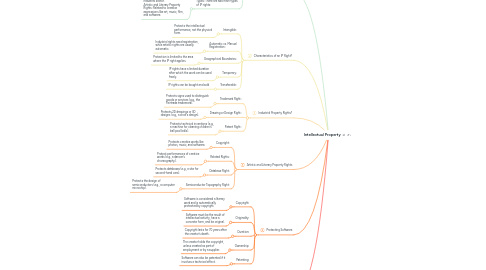
1. What is Intellectual Property?
1.1. Definition:
1.1.1. Intellectual Property (IP) rights are legal protections for creations of the mind.
1.2. Protection:
1.2.1. IP rights protect the intellectual performance, not the physical item.
1.3. Types: There are two main types of IP rights:
1.3.1. Industrial Property Rights: Related to products and services with an economic role in the industrial sector. Artistic and Literary Property Rights: Related to creative expressions like art, music, film, and software.
2. Characteristics of an IP Right?
2.1. Intangible:
2.1.1. Protects the intellectual performance, not the physical form.
2.2. Automatic vs. Manual Registration:
2.2.1. Industrial rights need registration, while artistic rights are usually automatic.
2.3. Geographical Boundaries:
2.3.1. Protection is limited to the area where the IP right applies.
2.4. Temporary:
2.4.1. IP rights have a limited duration after which the work can be used freely.
2.5. Transferable:
2.5.1. IP rights can be bought and sold
3. Industrial Property Rights?
3.1. Trademark Right:
3.1.1. Protects signs used to distinguish goods or services (e.g., the Fairtrade trademark).
3.2. Drawing or Design Right:
3.2.1. Protects 2D drawings or 3D designs (e.g., a chair's design).
3.3. Patent Right:
3.3.1. Protects technical inventions (e.g., a machine for cleaning children's ball pool balls).
4. Artistic and Literary Property Rights
4.1. Copyright:
4.1.1. Protects creative works like photos, music, and software.
4.2. Related Rights:
4.2.1. Protect performances of creative works (e.g., a dancer's choreography).
4.3. Database Right:
4.3.1. Protects databases (e.g., a site for second-hand cars).
4.4. Semiconductor Topography Right:
4.4.1. Protects the design of semiconductors (e.g., a computer microchip).
5. Protecting Software
5.1. Copyright:
5.1.1. Software is considered a literary work and is automatically protected by copyright.
5.2. Originality:
5.2.1. Software must be the result of intellectual activity, have a concrete form, and be original.
5.3. Duration:
5.3.1. Copyright lasts for 70 years after the creator's death.
5.4. Ownership:
5.4.1. The creator holds the copyright, unless created as part of employment or by a supplier.
5.5. Patenting:
5.5.1. Software can also be patented if it involves a technical effect.
6. Protecting Database
6.1. Copyright or Database Right:
6.1.1. Databases can be protected by copyright if creatively compiled or by database right if technically arranged.
6.2. Duration:
6.2.1. Database rights last for 15 years, renewable after substantial changes.
6.3. Ownership:
6.3.1. The producer of the database holds the rights.