


1. Hard on Climate policies (Henry, 2008)
1.1. Less Political Crime (Peoples, 2002)
1.1.1. Political Leadership (Douenne, 2020)
1.1.1.1. Build public Trust (Douenne, 2020)
1.1.1.2. Not allowed to invest in the stock market (Douenne, 2020)
1.1.2. Less corruption, bribery, state crime, and state-corporate crime (Peoples, 2002)
1.1.2.1. Less Social Injury (Peoples, 2002)
1.1.2.1.1. Less economic harm/inequality (Peoples, 2002)
1.1.2.1.2. Less environmental harm (Peoples, 2002)
1.2. Deregulation of Industry (Henry, 2008)
1.2.1. Restructuring the tax system (Douenne, 2020)
1.3. Interest group opposition (McSweeney, 2005)
1.3.1. No longer providing previous subsidies (McSweeney, 2005)
1.3.1.1. Retrenchment in oil subsidies (McSweeney, 2005)
1.3.1.1.1. Promotes shifting to climate-friendly options (McSweeney, 2005)
1.3.1.1.2. Economic Signal for Innovation (McSweeney, 2005)
1.3.1.1.3. Reduces Fossil Fuel Dependence (McSweeney, 2005)
1.3.1.2. Retrenchment in farm subsidies (McSweeney, 2005)
1.3.1.2.1. Decreasing Land Use Change (McSweeney, 2005)
1.3.1.2.2. Reduction in Overproduction (McSweeney, 2005)
1.3.1.2.3. Promoting Efficency (McSweeney, 2005)
1.4. Closure of tax loopholes (McSweeney, 2005)
1.4.1. New Tax Revenue can be used for **Climate Iniatives** (Douenne, 2020)
1.4.1.1. Green Infrustracture investments (i.e. more charging stations) (Douenne, 2020)
1.4.1.2. Tackle unemployment (Douenne, 2020)
1.4.1.3. Better Public Transit (Douenne, 2020)
1.4.1.4. Education Initatives on teaching carbon footprint (Douenne, 2020)
1.4.1.4.1. Media Literacy (Henry, 2008)
1.4.1.4.2. Remove Bias (Douenne, 2020)
1.4.1.4.3. Improve knowledge about climate change and climate policies (Douenne, 2020)
1.4.1.5. Free Media Time Influence of money in politics is eliminated due to the stoppage of campaign contributions. (Peoples, 2002)
1.5. Increased Taxes Such as fuel taxes (Douenne, 2020)
1.5.1. Losses public support. Yellow Vest Protests in France Issues of economic inequality Unfairly burdening the working and middle classes (Douenne, 2020)
1.5.2. Such as Carbon Fuel taxes (Douenne, 2020)
1.5.2.1. Dependence on automobiles reduced Increased usage of public transit (Henry, 2008)
1.5.3. Pigouvian taxes (Douenne, 2020)
1.5.3.1. Tax on red meat (Douenne, 2020)
1.5.4. Develop such policies as a substitute to a carbon tax (Douenne, 2020)
1.5.4.1. Subsidies for public transportation (Douenne, 2020)
1.5.4.2. Investments to thermal insulation (Douenne, 2020)
1.5.4.3. Subsidies for greener vehicles (Douenne, 2020)
1.5.4.4. Cap-and-trade reduction plan (Peoples, 2002)
2. Grassroot Movements (Douenne, 2020)
2.1. Campaigns and protests for inaction for environmental policies (Douenne, 2020)
2.2. Small Donations from crowd funding, and individual donors (Peoples, 2002)
2.3. Enthusiasts for reform (Douenne, 2020)
2.3.1. Increased Citizen Engagement (Henry, 2008)
2.3.2. Public Awareness (Henry, 2008)
3. Regulatory Reforms (McSweeney, 2005)
3.1. Change in campaign finance law (Henry, 2008; Peoples, 2002)
3.1.1. Contributions influence policy less (Peoples, 2002)
3.1.1.1. Less disinformation campaigns by lobbyists (Henry, 2008)
3.1.1.1.1. Climate Change Denial is perpetuated by .... (Henry, 2008)
3.1.1.1.2. Lobbying is st(ronger when an actor lobbies against a bill rather than in support of it (Peoples, 2002)
3.1.1.1.3. The uncertainty is in the predictions People are uneasy about inacting costly regulations (Henry, 2008)
3.1.1.2. Profits are prioritized less over climate change (Henry, 2008)
3.1.1.2.1. Climate Change affects (Henry, 2008)
3.1.2. Prevent unlimited contributions (McSweeney, 2005)
3.1.3. Restrict certain types or sources of contributions. Banning certain types of contributions (e.g. SuperPAC contributions or corporations in the fossil fuel industry) (Peoples, 2002)
3.2. intensified reporting requirements (McSweeney, 2005)
3.3. Contribution limits were added to candidates, parties, and committees (McSweeney, 2005)
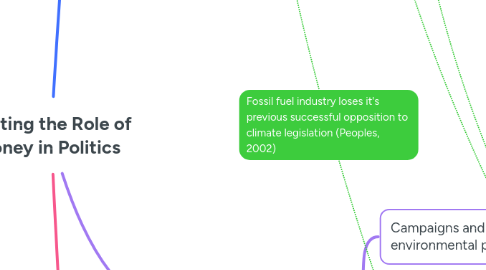
3.3.1. Fossil fuel industry loses prominent position within the power structure (Peoples, 2002)
3.3.2. Convince Congress to pass even weak bills to regulate greenhouse gas emissions This failure to pass before has largely been attributed to opposition from the fossil fuel industry (Peoples, 2002)
3.4. Legal Penalities (Peoples, 2002)
3.4.1. For Crimes such as...
3.4.1.1. Campaign contributions as facilitators of crime. (Peoples, 2002)
3.4.1.1.1. It can be concluded that campaign donations can, indeed, be considered criminal, at least when they result in social injury, like when opposing environmental bills that would result in environmental harm (Peoples, 2002)
3.4.1.2. Campaign contributions themselves as crimes. (Peoples, 2002)
3.4.1.3. Non-reported monetary support. Increasing amount of money falls into the hidden “independent expenditure” category (Peoples, 2002)