

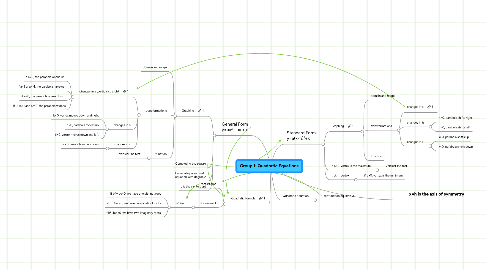
1. General Form y=ax²+ bx + c
1.1. Graphing
1.1.1. domain and range
1.1.2. transformations
1.1.2.1. changes in a (vertical stretch)
1.1.2.1.1. if a>0, the parabola opens up
1.1.2.1.2. if a>1 or a<-1, the parabola narrows
1.1.2.1.3. if a<0, the parabola opens down
1.1.2.1.4. if -1<a<1 and a≠0, the parabola widens
1.1.2.2. changes in b
1.1.2.2.1. b<0, vertex moves down and right
1.1.2.2.2. c>0, parabola moves up
1.1.2.2.3. b>0, vertex moves down and left
1.1.2.3. changes in c
1.1.2.3.1. c<0, parabola moves down
1.1.3. function
1.1.3.1. vertical line test
1.2. Completing the square
1.3. Univariate polynomial equation with degree 2
1.4. c is the y-intercept
2. Quadratic formula
2.1. roots/zeros
2.2. discriminant
2.2.1. b²-4ac
2.2.1.1. if b²-4ac=0, we have one distinct root
2.2.1.2. if b²-4ac>0, we have two dinstinct roots
2.2.1.3. if b²-4ac<0, we have two imaginary roots
3. x=h is the axis of symmetry
4. Standard Form y=a(x-h)²+k
4.1. Graphing
4.1.1. domain and range
4.1.2. transformations
4.1.2.1. changes in a
4.1.2.2. changes in h
4.1.2.2.1. h>0, parabola shifts right
4.1.2.2.2. h<0, parabola shifts left
4.1.2.3. changes in k
4.1.2.3.1. k>0, parabola shifts up
4.1.2.3.2. k<0, parabola shifts down
4.1.3. function
4.2. if a<0, vertex is the maximum
4.2.1. Vertical line test
4.3. (h,k) = vertex
4.3.1. if a>0, vertex is the minimum