


The Role of Translators and Interpreters
저자: renatta rosse carvajal castro
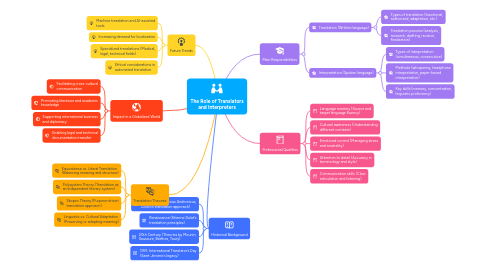
1. Historical Background
1.1. Ancient Rome (Livius Andronicus, Cicero’s translation approach)
1.2. Renaissance (Etienne Dolet’s translation principles)
1.3. 20th Century (Theories by Mounin, Saussure, Barthes, Toury)
1.4. 1991: International Translator’s Day (Saint Jerome's legacy)
2. Future Trends
2.1. Machine translation and AI-assisted tools
2.2. Increasing demand for localization
2.3. Specialized translations (Medical, legal, technical fields)
2.4. Ethical considerations in automated translation
3. Translation Theories
3.1. Equivalence vs. Literal Translation (Balancing meaning and structure)
3.2. Polysystem Theory (Translation as an independent literary system)
3.3. Skopos Theory (Purpose-driven translation approach)
3.4. Linguistic vs. Cultural Adaptation (Preserving or adapting meaning)
4. Impact in a Globalized World
4.1. Facilitating cross-cultural communication
4.2. Promoting literature and academic knowledge
4.3. Supporting international business and diplomacy
4.4. Enabling legal and technical documentation transfer
5. Main Responsibilities
5.1. Translation (Written language)
5.1.1. Types of translation (functional, authorized, adaptation, etc.)
5.1.2. Translation process (analysis, research, drafting, revision, finalization)
5.2. Interpretation (Spoken language)
5.2.1. Types of interpretation (simultaneous, consecutive)
5.2.2. Methods (whispering, headphone interpretation, paper-based interpretation)
5.2.3. Key skills (memory, concentration, linguistic proficiency)