


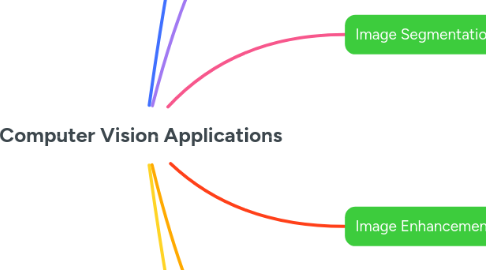
1. Image Recognition & Classification
1.1. General Image Classification
1.1.1. Classify an image into categories
1.2. Face Recognition
1.2.1. Identify or verify a person based on facial features.
1.3. Scene Recognition
1.3.1. Identify the type of environment (e.g., beach, forest, city).
1.4. Medical Image Classification
1.4.1. Detect diseases in X-ray, MRI, CT images.
2. Object Detection & Tracking
2.1. Object Detection
2.1.1. Detect and label objects with bounding boxes.
2.2. Multi-Object Tracking
2.2.1. Track multiple moving objects across frames.
2.3. Pedestrian Detection & Tracking
2.3.1. Identify and track people for safety or analytics.
2.4. Vehicle Detection for Autonomous Driving
2.4.1. Detect vehicles, lanes, and traffic signs.
3. Image Segmentation & Pixel-level Analysis
3.1. Semantic Segmentation
3.1.1. Classify every pixel into a category.
3.2. Semantic Segmentation
3.2.1. Identify each object instance separately.
3.3. Panoptic Segmentation
3.3.1. Combines semantic and instance segmentation.
4. Image Enhancement & Restoration
4.1. Super-Resolution
4.1.1. Increase image resolution using AI.
4.2. Image Denoising
4.2.1. Remove noise from images.
4.3. Image Inpainting
4.3.1. Fill in missing parts of an image.
4.4. Image Colorization
4.4.1. Add color to grayscale images.
5. Generative Vision & Creative AI
5.1. Text-to-Image Generation
5.1.1. Generate an image from text prompts.
5.2. Neural Style Transfer
5.2.1. Apply artistic styles to photos.
5.3. Deepfake Generation
5.3.1. Replace a person’s face in video.
5.4. mage-to-Image Translation
5.4.1. Convert an image from one domain to another.
6. Real-world Industrial Applications
6.1. Manufacturing Quality Inspection
6.1.1. Detect defects in production lines.
6.2. Retail & Customer Analytics
6.2.1. People counting, heatmaps, shopper tracking.
6.3. Agriculture
6.3.1. Identify plant diseases or monitor crop growth.
6.4. Security & Surveillance
6.4.1. Intrusion detection, suspicious activity monitoring.