


1. brand positioning: act of designing the companies offer and image so that it occupies a distinct and value place in the target customers minds
1.1. points of parity
1.1.1. association are not necessarily unique to the brand but may, in fact, be shared with other brands
1.2. points of difference
1.2.1. attributes or benefits that consumers strongly associate with a brand,
2. competitive frame of reference: a brand positioning is to determine category membership, inform consumers of a brands category membership before stating its point of difference in relationship to other category memebers
2.1. deciding to target a certain type of consumer often defines the nature of competition
2.2. how the brand is similar to these types of competitiors
2.3. how the brand is different
3. brand mantra: an articulation of the 'heart and soul' of the brand
3.1. short three-to five- word phrases that capture the irredufutable essence or spirit of the brand positioning and brand values
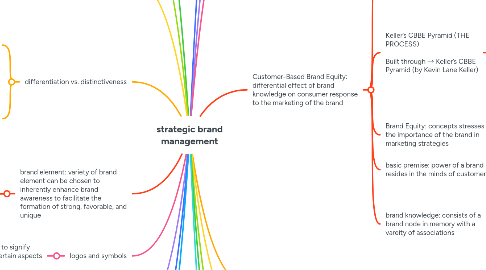
4. differentiation vs. distinctiveness
4.1. differentiation: a strategic approach that highlights unique product features, brand image, or service quality to distinguish a company from competitors and attract specific customer segments
4.2. distinctivness: the practice of creating unique, memorable, and easily recognizable brand assets—such as logos, colors, taglines, or sounds—that allow consumers to instantly identify a brand among competitors
5. brand element: variety of brand element can be chosen to inherently enhance brand awareness to facilitate the formation of strong, favorable, and unique
5.1. should be inherently by memorable and attention-grabbing and therefore facilitate recall or recognition
6. logos and symbols
6.1. logos: often changed to signify change or promote certain aspects of the brand identity
6.1.1. should be Memorability, Meaningfulness, Likeability, Transferability, Adaptability, Protectability
6.1.1.1. Marketer’s Offensive strategy to build brand equity Defensive role for leveraging and maintaining brand equity
7. integrated marketing
7.1. marketers contribute to brand equity by establishing the brand in memory and linking strong, favourable, and unique associations to it
7.2. exposure->attention->comprehension->yielding->intention->behavior
8. experiential marketing: often involves special events, contests, promotions, sampling, and online activites
9. one-to-one marketing
9.1. consumer differentations
9.1.1. treat different consumers differently
9.1.2. different needs
9.1.3. different values to firm
10. VULC
10.1. Volatility: Changes occue much more often than before and require continous analysis and evaluation
10.2. uncertainty: we are not able to unambigously predic and priotitize factos that may influence the situation
10.3. complexity: number of factors determining the development process increases become unknown
10.4. ambiguity: information is difficult to interpret unequivocally. past experiances are not applicable to processes and events
11. Brand: a name, term, sign, symbol, design or a combination of these that identifies & differentiates product/service offering of one seller from that of others in a marketplace
12. marketing: act of acquiring, satifying, and retaining customers
12.1. the activity, set of institutions, and processes for creating, communicating, delivering, and exchanging offerings that have value for customers, clients , partners, and society
13. Customer-Based Brand Equity: differential effect of brand knowledge on consumer response to the marketing of the brand
13.1. basic premise- postive or negative customer-based equity when consumers react more or less favorably to an element of the marketing mix when it is attributed to a fictiicously named or unnamed verision of the prodcut or service
13.1.1. this occurs when the consumer is familiar with the brand and holds some favorable, strong, and unique brand associations in memory
13.2. Keller’s CBBE Pyramid (THE PROCESS) Built through → Keller’s CBBE Pyramid (by Kevin Lane Keller)
13.2.1. Building Blocks: Salience, Performance, Imagery, Judgments, Feelings, and Resonance
13.2.1.1. Customer perceptions & responses Sub-branches: Awareness Associations Attitudes Loyalty Performance & Imagery Judgements & Feelings Resonance CBBE lives in the customer’s mind
13.3. Brand Equity: concepts stresses the importance of the brand in marketing strategies
13.4. basic premise: power of a brand resides in the minds of customers
13.5. brand knowledge: consists of a brand node in memory with a vareity of associations
13.5.1. key to creating brand equity, creates differential effect that drives brand equity
13.5.1.1. brand awareness
13.5.1.1.1. brand recall: occurs when a category, need, or other general stimulus gets you to think of the brand
13.5.1.2. brand image
13.5.1.2.1. Associations: Linked ideas, feelings, experiences
14. Stages of brand development
14.1. idenity: who are you, and when and why do i think of you
14.1.1. meaning: what are you, and makes you special?
14.1.1.1. response: what do i think and feel about you?
14.1.1.1.1. relationships: what about you & me? going forward
15. URLs: specify locations of pages on the web and are also commonly referred to as domain names
16. premium pricing
16.1. price is a indicator of quality,
16.2. customers percieve quality differences in competitive offering and are prepared to pay for quality
16.3. customers are concerned about being seen to buy the most expensive
17. personalized marketing: provides holistic, personalized brand experiances to create stronger consumer ties
18. permission marketing: encourages consumers to participate in a long term interactive marketing campaign in which they are rewarded some way for paying attention to increasingly relveant messages
18.1. anticpated: people look forward to hearing from you
18.2. personal: the messages are directly related to the indivdual
18.3. relevant: the marketing is about something the prospect is interested in
18.3.1. interruption marketing can be intrustive and disruptive and can alienate your customer