

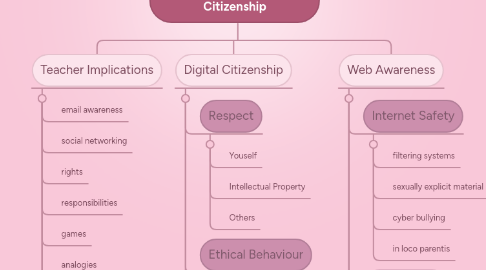
1. Teacher Implications
1.1. email awareness
1.2. social networking
1.3. rights
1.4. responsibilities
1.5. games
1.6. analogies
1.7. student projects
1.8. role playing
1.9. guest speakers
1.10. resources
1.10.1. cybersmart!
1.10.2. i-safe curriculum
1.10.3. mediasmarts
1.10.4. web quest
2. Digital Citizenship
2.1. Respect
2.1.1. Youself
2.1.2. Intellectual Property
2.1.3. Others
2.2. Ethical Behaviour
2.2.1. Identity
2.2.2. Privacy
2.2.3. Ownership
2.2.4. Trustworthyness
2.2.5. Participation
2.3. Protect Themselves
2.4. Netiquette
2.4.1. Anonymous
2.4.2. Clear Communication
2.4.3. Formal vs. Informal
2.4.4. Humour
2.4.5. Reread
2.4.5.1. Tone
2.4.5.2. Grammar
2.4.5.3. Spelling
2.4.6. Not Private
3. Web Awareness
3.1. Internet Safety
3.1.1. filtering systems
3.1.2. sexually explicit material
3.1.3. cyber bullying
3.1.4. in loco parentis
3.2. Authenticity
3.2.1. authority
3.2.2. coverage
3.2.3. objectivity
3.2.4. accuracy
3.2.5. currency
3.2.6. email validity
3.3. Marketing
3.3.1. targets kids
3.3.1.1. pestering
3.3.1.2. psychology
3.3.1.3. brand loyalty
3.3.1.4. buzz
3.4. Privacy
3.4.1. geotagging
3.4.2. personal publishing
3.4.2.1. audience
3.4.2.2. anonymity
3.4.2.3. permanence
3.4.2.4. copyright
3.4.2.5. free speech
3.5. Copyright
3.5.1. intellectual property
3.5.1.1. public domain
3.5.1.2. trademark
3.5.1.3. fair dealing
3.5.1.4. fair use
3.5.2. copy / paste