


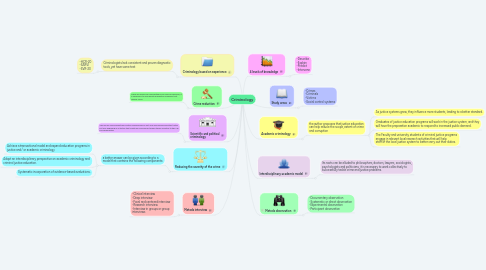
1. Crime reduction
1.1. There will always be unacceptable and criminal behavior, it is necessary to incorporate preventive programs that reduce crime
2. Reducing the severity of the crime
2.1. a better answer can be given according to a model that contains the following components:
2.1.1. Achieve a transactional model and expand education programs in justice and / or academic criminology
2.1.2. Adopt an interdisciplinary perspective on academic criminology and criminal justice education.
2.1.3. Systematic incorporation of evidence-based evaluations.
3. Criminology based on experience
3.1. Criminologists lack consistent and proven diagnostic tools, yet have some test
3.1.1. -HCR-20 -SARVI -SVR-20
4. Scientific and political criminology
4.1. The role as criminologists and justice professionals is not only discovering scientific truths but also engaging in activities that create an environment where those scientific truths can be implemented.
5. Metods interview
5.1. -Clinical interview -Deep interview -Focal and centered interview -Research interview -Interview in groups or group interviews
6. Study areas
6.1. -Crimes -Criminals -Victims -Social control systems
7. Academic criminology
7.1. the author proposes that justice education can help reduce the scope, extent of crime and corruption
7.1.1. As justice systems grow, they influence more students, leading to a better standard.
7.1.2. Graduates of justice education programs will work in the justice system, and they will have the preparation academic to respond to increased public demand.
7.1.3. The Faculty and university students of criminal justice programs engage in relevant local research activities that will help staff of the local justice system to better carry out their duties.