
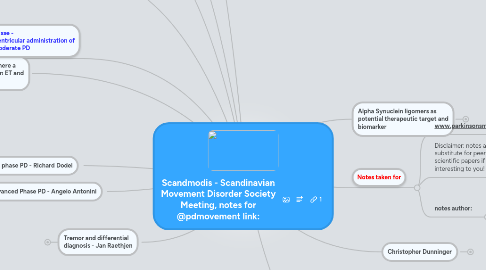
Scandmodis - Scandinavian Movement Disorder Society Meeting, notes for @pdmovement link:


1. Tremor and differential diagnosis - Jan Raethjen
1.1. Essential tremor
1.1.1. ET vs PD tremor
1.1.1.1. 10% of ET patients have some degree of resting tremor -- makes diagnostic process harder
1.1.1.2. postural tremor vs rest tremor
1.1.1.3. DAT scan - ET vs PD tremor
1.1.1.4. transcranial sonography
1.1.1.5. Accelerometric tremoranalysis
1.1.1.5.1. muthuraman 2011
1.2. dystonic
1.3. cerebellar
1.3.1. ET vs cerebellar
1.3.1.1. ataxia in both
1.3.1.2. ET + alcohol = tremor decreases
1.3.1.3. finger-nose exercise
1.3.1.4. Gait disorders in ET
1.3.1.4.1. with/without alcohol
1.4. parkinsonian
1.5. functional
1.5.1. Moving toward 'laboratory supported" criteria for psychogenic tremor, mov dis 2011, Schwingenschuh et al
1.5.2. ET vs Dystonic tremor
1.5.2.1. Some controversial aspects
1.6. Efficacy of treatments
1.6.1. elble et al 2007
1.7. Treatment of PD tremor
1.7.1. table w various steps
1.7.1.1. step 1
1.7.1.2. step 2
1.7.1.3. step 3
1.7.1.3.1. DBS for tremor
1.8. Why does thalamic stimulation selectively abolish termor leaving voluntary motor control in tact?
1.8.1. thalamocortical loop
2. Early phase PD - Richard Dodel
2.1. Centennial of the description of Lewy bodies 1912
2.2. Guidelines
2.2.1. S1
2.2.1.1. Expert
2.2.2. S3
2.2.2.1. Highest level of evidence
2.3. Main targets
2.3.1. pathophysiology
2.3.2. Meissner et al. Nat Rev Drug Discov 2011
2.4. LSVT BIG
2.4.1. ebersbach et al Mov Disord 2010
2.5. CBT in PD
2.5.1. Psychiatric complications: Depression
2.5.2. more focus on non drug treatment
2.6. notes missed
2.7. Conclusion
2.7.1. no evidence for neuroprotective therapies
2.7.2. no evidence for disease modifying therapies
2.7.3. gaps in evidence based therapy of early pd
2.7.4. considerable preliminary evidence for effect of CBT and physiotherapy
2.7.5. one missed
3. Advanced Phase PD - Angelo Antonini
3.1. Patient diary of a patient w advanced PD
3.2. based on effectiveness of levodopa
3.3. notes not taken
4. Kailash Bhatia - is there a connection between ET and PD?
4.1. What is ET?
4.1.1. e.g. Hereditary myoclonic Dystonia, Hereditary Torsion Dystonia and Hereditary Essential Myoclonus - an area of confusion --> terms disappeared from literature now...
4.2. Paper: Tremor - Some controversial aspects
4.3. MDS consensus criteria for ET
4.3.1. exclusion criteria include...dystonia etc.
4.4. Deuschl et al, Muslce Nerve 2001
4.5. controversy
4.5.1. ET and dystonia
4.5.2. ET and PD
4.5.3. how common is ET
4.5.3.1. epidemiology studies a 2750 fold difference among 20 studies
4.5.4. Tremor in unselected "normal" elderly
4.5.4.1. 98,7% has it
4.5.4.2. aged people w tremor usually dont visit clinics for this, but for other causes
4.5.5. "Benign" Essential Tremor (ET) the most common movement disorder
4.5.5.1. why in sporadic disorder PD a number of genes known
4.5.5.2. why in ET no genes found while most prevalent movement disorder and dominant inherited?
4.5.5.2.1. groups not homogeneous
4.5.6. The bimodal peak
4.5.6.1. early in life
4.5.6.2. later in life
4.5.6.3. which disease do you know w a bimodal peak?
4.5.6.3.1. actual different conditions?
4.5.7. Louis group
4.5.7.1. tremor of the head
4.5.7.1.1. more likely in women
4.5.7.1.2. more likely in late onset
4.6. Isolated ET of jaw
4.6.1. hypertrofic jaw muscle.. dystonia?
4.7. Is ET pathologically one disease?
4.7.1. Louis 2007, Shill 2008
4.7.2. no consistent pathology in ET
4.8. What other conditions are commonly mistaken for ET and vice versa?
4.8.1. enhanced physiological tremor
4.8.2. tremulous dystonia or dystonic tremor
4.8.3. pd
4.9. paper: Prevalence of movement disorders in men and women aged 50-89 age
4.10. Consensus statement of MDS on tremor
4.10.1. dystonic tremor: tremor in a body part that is affected by dystonia
4.10.2. Tremor associated w dystonia: tremor in a body part not affected by dystonia, but the patient has dystonia elsewhere
4.10.3. Dystonia gene-associated tremor: isolated tremor in patients with a dystonic pedigree
4.10.4. Deuschl. et al
4.11. Is ET associated w PD or PD w ET?
4.11.1. ET pts may only come to doctor when something else happens (e.g. development of PD)
4.11.2. PD may be tremor dominant (eg parkin disease can present w just tremor for many years)
4.11.3. Further misdiagnosis between familial dystonic tremor, PD and ET
4.12. various clinical cases presented
4.13. Message: be very careful w calling something ET
4.13.1. ET-no-nos
4.13.1.1. unilateral/very asymmetric arm tremor
4.13.1.2. etc..
4.13.2. lack of gold standard
5. Gesine Paul-Visse - Intracerebroventricular administration of PDGF-BB in moderate PD
5.1. Rationale
5.1.1. PDGF-BB
5.1.1.1. well known in angiogenesis
5.1.1.2. Recombinant human PDGF-BB = drug substance becaplermin
5.1.1.2.1. Regraneux
5.1.1.2.2. GEM 21S
5.1.2. PDGF in vitro neuroprotective for fetal DA neurons exposed to 6-OHDA
5.1.3. In vivo model: restorative effect PDGF-BB
5.1.3.1. increases periventricular cell proliferation
5.1.3.1.1. Zachrisson et al 2011
5.1.3.2. PDGF-BB increases nr of TH positive cells - effect is proliferation dependent
5.1.3.2.1. a mitosis inhibitor stops the effect
5.1.3.3. PDGF-BB increases striatal DAT binding-effect is proliferation dependent
5.1.3.4. Affects behavior!
5.1.3.5. suggested mechanism of action
5.1.3.5.1. missed notes
5.2. PDGF-BB for PD - a potentially disease modifying treatment
5.2.1. snn0031
5.2.2. Treatment paradigm
5.2.2.1. repeated injection will lead to disease modifaction
5.2.3. substance does not cross blood-brain barrier
5.2.3.1. delivered by pump
5.2.3.1.1. pump by medtronic
5.2.4. inclusion criteria
5.2.4.1. missed
5.2.5. outcome measures
5.2.5.1. primary objective
5.2.5.1.1. to assess safety and tolerability of drug, device and procedure
5.2.5.1.2. adverse events
5.2.5.1.3. vital signs
5.2.5.1.4. ecg
5.2.5.1.5. safety lab
5.2.5.1.6. cranial mri
5.2.5.1.7. fundoscopy
5.2.5.1.8. MMSE
5.2.5.1.9. MADRS
5.2.5.2. secondary
5.2.5.2.1. UPDRS
5.2.5.2.2. EQ-5D
5.2.5.2.3. DAT-PET
6. Jeff Kordower - Nurturing Gene therapy for PD
6.1. Ongoing clinical trials
6.1.1. symptomatic therapy
6.1.1.1. AAV2-AADC (genzyme/Avigen)
6.1.1.2. AAV2-GAD ( )
6.1.1.3. needs to make things better...better than what?
6.1.1.3.1. better than DBS
6.2. protection(trofic factors)
6.2.1. GDNF
6.2.1.1. does not work in Alfa synuclein models(!) - Lo Bianco
6.2.1.2. Prevention of fine-motor deficits in mptp-treated monkeys by lentiviral gene delivery of GDNF
6.2.1.2.1. does give good results
6.2.2. Neurturin
6.2.2.1. GDNF --> in clinics stopped../intellectual property
6.2.2.2. signals through GDNF pathway
6.2.2.3. Neurturin is expressed in the caudate and putament following AAV-NTN (CERE-120) administration
6.2.2.4. symptomatic benefit MUST be demonstrated, in order to power studies
6.2.2.4.1. ADAGIO study --> showed that much is needed to show neuroprotective effect
6.2.2.5. Able to increase level of dopamine w the delivery
6.2.2.5.1. response = dose dependent
6.2.2.6. Monkey study
6.2.2.6.1. MPTP
6.2.2.6.2. MPTP + neurturin
6.2.2.7. Phase 1
6.2.2.7.1. open label
6.2.2.8. Phase 2
6.2.2.8.1. inject vector in putamen
6.2.2.8.2. trial failed
6.2.2.8.3. Marks Olanow, Lancet
6.2.2.8.4. Change from Baseline in UPDRS (Part II) motor score "off"
6.2.2.8.5. not significant in 12 months... some got significant after 18 months
6.2.2.8.6. three challenges
6.2.2.9. where next?
6.2.2.9.1. inject in striatum
6.2.2.9.2. inject in SNc
6.2.2.9.3. increase dose
6.2.2.9.4. hope: enhanced clinical benefit
6.2.2.10. Early patients
6.2.2.10.1. biomarker
6.2.2.11. Conclusions
6.2.2.11.1. more complicated than thought: use of trofic factors
6.2.2.11.2. go big or go home..
6.2.2.11.3. etc..
6.2.3. ARTN
6.2.4. PSPN
7. Eduardo Tolosa - Barcelona, Spain - Neuropharmacological treatment: pipeline and future perspectives
7.1. new therapies in clinical development
7.1.1. motor problems
7.1.1.1. dopaminergic agents
7.1.1.1.1. IPX066
7.1.1.1.2. apomorphin inhalation
7.1.1.1.3. Safinamide
7.1.1.1.4. pardoprunox
7.1.1.1.5. etc
7.1.1.2. non-dopaminergic agents
7.1.1.2.1. Normal
7.1.1.2.2. Dyskinetic
7.1.1.2.3. :lancet Neurol 2008;7:927-38
7.1.1.2.4. Preladenant
7.1.1.2.5. AFQ056 - novartis
7.1.1.2.6. Perampanel
7.1.1.2.7. Fipamezole
7.1.2. non-motor problems
7.1.2.1. Pathological gambling in PD is reduced by Amantadine
7.1.2.2. Amantadine use associated w impulse control disorders in PD...
7.1.2.2.1. dominion study, contradictory results
7.1.2.3. Falling
7.1.2.3.1. Reduce frequency of falls w Central cholinesterase inhibitor
7.1.2.4. Postural hypotension
7.1.2.4.1. L-DOPS
7.1.2.4.2. New node
7.2. other type of therapies
7.2.1. Physical exercise
7.2.1.1. LSVT BIG study
7.2.1.2. Self-management Rehabilitation and Health-Related Quality of Life in PD: a RCT
7.2.1.3. Tai Chi and Postural Stability in PD patients, NEJM
8. Tony Schapira - modifying PD
8.1. What
8.1.1. Schapira & Tolosa, Nat Rev. Neurol
8.1.1.1. New node
8.1.2. Mitochondrial function
8.1.3. Aging
8.1.3.1. lysosomal function decrease
8.1.3.2. autophagy function decreases
8.1.4. Oxidative forforylation and free radical creation
8.1.5. LRRK-2, many targets which cause fosforylation
8.1.5.1. alfa syn fosforylation
8.1.5.2. kinase inhibitors
8.1.6. Process of Autophagy
8.1.6.1. alfa synuclein degradation
8.1.6.2. destruction of organelles
8.1.6.2.1. mitochondria
8.1.7. Transport of mitochondria
8.1.8. Turn over of mitochondria
8.1.8.1. Repair?
8.1.8.2. Destroy?
8.1.9. Gegg et al 2010 HMG, Rakovic et al PLOS One
8.1.10. PGC-1 Alfa
8.1.10.1. increase mitochonrdial mass in physiological terms
8.1.11. Potential Therapeutic targets
8.1.11.1. Many!
8.1.11.2. Ca channel modulators
8.1.11.3. protein disaggregation
8.2. Who?
8.2.1. Genetic causes of PD
8.2.1.1. PARK genes
8.2.1.1.1. g2190s mutation
8.2.1.1.2. LRRK2 is common
8.2.2. environment
8.2.2.1. insignificant compated to genetic causes
8.2.3. should we develop personalised medicine for individuals w particular biochemical markers?
8.2.3.1. Cohorts of individuals w certain risk factors may benefit of some approaches, while others will not
8.2.3.2. DATATOP: Vit E/urate
8.2.3.3. LRRK2 inhibitors
8.2.3.4. GBA carriers
8.2.3.5. Ashkenazi jews
8.2.4. General application?
8.2.4.1. mitochondrial enhancers
8.2.4.2. ?
8.2.4.3. ?
8.3. When to treat?
8.3.1. logic: as soon as possible
8.3.2. prodromal stage
8.3.2.1. molecular
8.3.2.2. clinical
8.3.3. whom are the right patients?
8.4. How
8.4.1. how to treat
8.4.2. how to test
8.4.3. neuroprotection trial characteristics
9. Anders Björklund - Nurr1
9.1. why is it interesting in PD?
9.1.1. papers on a possible link
9.2. no notes made
10. Genetic Aspects in Parkinson's Disease
10.1. Speaker
10.1.1. Thomas Gasser
10.2. Genetic Parkinsonism
10.2.1. Case presentation
10.2.2. genetic/non-genetic parkinsonisms, are not categorical distinguishable (not helpfull)
10.2.3. Many genes are involved
10.2.4. Some monogenetic ones
10.2.5. Early onset recessive PD
10.3. Feasibility of identifying genetic variants by risk-allele frequency and strength of genetic effect - 2009, Nature
10.4. Park 1/4
10.4.1. Alpha synuclein mutations
10.4.2. Some people think it's the central gene in pathophysiology
10.5. alfa-syn pathology in LRRK2 - mutations
10.5.1. Large variations in prevalence across world
10.6. Monogenic - risk factor genetic
10.6.1. This border begins to blur
10.7. Two pathways to PD
10.7.1. Mitophagy pathway
10.7.2. Alfa synuclein
10.7.3. Relation between these pathways not clear
10.8. Promising new technology
10.8.1. whole exome sequencing
10.8.2. Zimprich et al AJHG 2011
10.9. VPS 35 gene in PD
10.9.1. is it pathogenic?
10.9.2. what does this mutation mean?
10.9.3. Sharma et al, submitted
10.9.4. A multi-centered clinico-genetic analysis of the VPS35 gene in PD
10.10. Gaucher disease and PD
10.10.1. Gaucher disease
10.10.1.1. non-neuropathic type I
10.10.1.2. acute neuropathic type II
10.10.1.3. subacute neuropathic type
10.10.1.4. Multicenter analysis of glucocerebrosidase mutations in PD
10.10.2. GBA-associated PD presents with nonmotor characteristics
10.10.2.1. specific treatment?
10.11. Monogenic PD
10.11.1. tip of iceberg
10.11.2. Population stratifications
10.12. Genome wide association studies
10.12.1. Simon=sanchez et al, nat genet 2009
10.12.2. Satake et al - nat genetic 2009
10.12.3. pittman et al hum. mol. genet. 2004
10.12.4. Tau gene
10.12.4.1. haplotypes and gene expression implicate the MAPT region in PD
10.12.4.2. Different regions in brain and Tau metabolism - John Hardy
10.13. Are there more genes
10.13.1. simon sanchez et al PlosOne 2012
10.13.2. protein homeostasis pathway
10.13.3. energy homeostasis in mytochondria
10.13.4. There may be a few interlinked pathways rather than one common pathway
10.13.5. e.g. stratification of patients with certain degrees of various pathways involved could be a way forward
10.14. In sporadic cases
10.14.1. We need to move away from single gene, single therapy idea toward systems approach
11. Christopher Dunninger
11.1. Prion-like disease mechanism in PD?
11.2. Neuronal survival unit
11.2.1. Lab of Patrik Brundin
11.3. Neuropathology
11.3.1. mid brain dopaminergic neurons die
11.3.2. lewy bodies indicate protein misfolding
11.3.3. braak hypothesis- describes progression of lewy pathology
11.4. Alfa synuclein
11.4.1. proposed rol in vesicle transport
11.4.2. ..
11.4.3. a-synuclein increases in age
11.4.3.1. correlated w dopamine neuron loss
11.4.3.2. 12 year old grafted neurons
11.4.3.2.1. 40% lewy bodies
11.4.3.3. 16 year old grafted neurons
11.4.3.3.1. 80% has lewy bodies
11.5. Braak staging of Lewy related pathology in PD
11.5.1. lewy bodies progress in time and place
11.5.2. clinical correlates
11.6. Grafting
11.6.1. lewy bodies in grafts
11.6.2. oxidative stress?
11.6.3. Excitotoxicity?
11.6.4. Coming from host brain?
11.6.4.1. most controversial.../interesting
11.6.4.2. alfa syn cell to cell transfer
11.6.5. does transmitted alfa synuclein recruit endogenous protein?
11.6.6. does the fluorescent substance "cause" the transfer?
11.7. Can transmitted alfa syn. seed aggregation?
11.7.1. bimoleculare fluorescence complementation (BiFC)
11.7.1.1. this happens
11.7.1.2. no proof of aggregation
11.7.1.3. proof of interaction
11.7.2. Animal modelling
11.7.2.1. alfa synuclein seeding in vivo?
11.8. Exosomes
11.8.1. Alfa syn has been seen in exosomes
11.8.2. 100 nanometers
11.8.2.1. 50 microliters of CSF needed for assay
11.8.3. cell culture model is replicating work of 2 other groups
11.8.4. Exosomes containing alfa synuclein affect kinetics of alfa synuclein aggregation
11.8.5. Exosomes are interesting why?
11.8.5.1. can probably spread pathology
11.8.5.2. can be of use in therapy
11.8.6. We know alfa syn spreads from cell to cell, but how we dont know
12. Alpha Synuclein ligomers as potential therapeutic target and biomarker
12.1. Martin Ingelsson, MD, PhD
12.1.1. Uppsala
12.2. Lewy bodies/neurites consist of alfa synuclein
12.2.1. Alfa syn aggergation pathway
12.2.1.1. tetramer -> monomer
12.2.1.1.1. -->misfolded protein
12.2.1.1.2. controversy on this step
12.3. Oxidative stress and formation of reactive aldehydes
12.3.1. to induce oligomers
12.3.2. to stabilise oligomers
12.3.3. Nasström et al.
12.3.4. alfa synuclein oligomers cause mitochondrial toxicity
12.3.5. Checking oligomers to various systems to check toxicity
12.3.6. Alfa synuclein oligomers decrease long term potentiation (LTP) in rat hippocampal neurons
12.3.6.1. oligomers have impact on this
12.3.7. Generation of monoclonal alfa synuclein antibodies
12.3.7.1. hybridoma production
12.3.7.2. made in mice
12.3.7.3. characterization of alfa syn oligomer selective antibodies
12.3.7.3.1. fagerqvist et al
12.3.8. Oligomer selective antibodies are internalized in H4 neuroglioma cells
12.3.8.1. Nässtrom et al Plos One 2011
12.3.9. The 49G antibody can interfere with early steps of alfa synuclein aggregation
12.3.9.1. bifluorescence complimentation assay
12.3.10. missed some notes here..
13. Notes taken for
13.1. www.parkinsonsmovement.com
13.2. Disclaimer: notes are personal notes, no substitute for peer reviewed work, please verify scientific papers if anything written here is interesting to you!
13.3. notes author:
13.3.1. Paul de Roos
13.3.2. www.paulderoos.com
13.3.3. http://www.twitter.com/paulderoos