


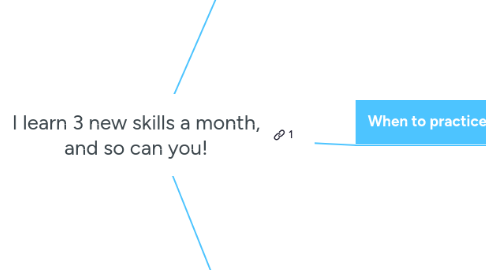
1. How to choose your new skills
1.1. Choose 3 skills that use completely different sections of the brain.
1.1.1. Eg:
1.1.1.1. Logic/Science (Programming, Math, Physics, etc.)
1.1.1.2. Creative (Art, Music, Writing, Design, Movies, etc.)
1.1.1.3. Languages
1.1.1.4. Health (Nutrition, Body-building, Sports)
1.1.1.5. Speech (public speaking, speed, tone, etc.)
1.2. Be Specific and Realistic
1.2.1. Don't choose a broad skill like programming
1.2.2. Being realistic and specific will help you focus and stay motivated, and ultimately help you stay consistent in your practice.
2. When to practice them
2.1. Practice each skill 30 minutes per day
2.1.1. Thirty minutes for each skill is achievable. If it’s unreasonable for you, just reduce to 1–2 skills instead.
2.1.2. In 15 hours (30 minutes X 30 days), you can learn A LOT.
2.2. Have a schedule
2.2.1. Be extreme in telling your brain that you HAVE TO do it or something bad will happen.
2.2.2. Do it consistently at the same time every day.
2.2.3. Learn the skills when you have the highest amount of energy during the day.
2.3. Passive Learning
2.3.1. During your day, you spend a lot of time doing passive things: Commuting to work, basic cooking, etc.
2.3.2. Use this time to learn passively.
2.3.3. Find good articles online, podcasts and videos to teach you the theory required to learn a skill.
2.3.4. Just put your headphones on and learn while doing those passive activities. Learn the jargon, the techniques, etc.
2.3.5. Don’t spend all your time on theory, spend some time to practice as well
3. How to measure improvements (build momentum)
3.1. Measuring
3.1.1. Track your progress. Your brain needs a little dopamine rush to keep you going.
3.1.2. When you start listing skills you’re interested in learning, give yourself milestones with hard deadlines.
3.1.3. Break down the skill in manageable sub-skills required to reach the status of “acquired”.
3.1.4. Have simple checkboxes to track progress. When you’re good enough in the sub-skill, check that box
3.2. Going forward
3.2.1. By the end of the month, you should have plenty of momentum. Up to you to decide what to do with it.
3.2.1.1. Continue Learning
3.2.1.1.1. Take advantage of the momentum and accelerate your learning even more. Try to become a “master” at it.
3.2.1.2. Find a complementary skill
3.2.1.2.1. Focus on a more specific subset of a particular skill, or a different branch.
3.2.1.3. Do something else entirely.
3.2.1.3.1. Doing something else entirely breaks the momentum for that skill
3.2.1.3.2. But the success you had from learning previous skills should carry over and keep you motivated.
3.2.1.3.3. Your brain will now accept that you can indeed learn things you never knew you could.