
An investigation of best practice for Circular Design Practices in the Irish Furniture Sector for...


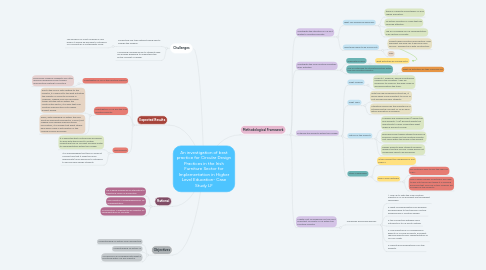
1. Objectives
1.1. Understanding CE within Irish Manufacture
1.2. Understanding CE within LF
1.3. Comparing CE Knowledge with what is practiced within HE and Industry
2. Rational
2.1. CE is being pushed as an alternative to traditional forms of production
2.2. Irish Industry is underprepared for CE Implementation
2.3. CE Education is highlighted as essential for implementation of circlarity.
3. Expected Results
3.1. Investigation of CE in the furniture industry
3.1.1. Preliminary research suggests very little research regarding project-based manufacture relating to furniture.
3.2. Investigation of CE and the Irish furniture industry
3.2.1. Due to the lack of data relating to the industry, it is difficult to tell what activities the industry is currently involved in. However, judging from pre-recession trends and the upturn within the construction sector, it is likely that Irish furniture manufacture is still highly project-based.
3.2.2. Again, data regarding CE within the Irish furniture manufacturing sector is scant, but judging from general manufacturing information, it is unlikely that great strides have been made in anticipation of the coming Circular Economy.
3.3. Trial projects
3.3.1. It is expected that Lecturers will be willing to work with the project to further understand the CE concept and help foster its implementation within the college.
3.3.2. It is acknowledged that this is a difficult concept and that it might be more appropriate/ more benificial to introduce to second year design students
4. Challenges
4.1. conducting live trials without being able to change the syllabus.
4.1.1. The syllabus for most modules is very broad. It should be possible to introduce CE concepts as a sustainability issue.
4.2. Conveying complex issues to students who are already grappling to understand the entire concept of design.
5. Methodological Framework
5.1. Investigate the literature on CE as it relates to furniture industry.
5.1.1. what can already be deduced?
5.1.1.1. there is a definite link between CE and Higher Education.
5.1.1.2. CE within Furniture is a field that has recieved attention.
5.1.1.3. The EU is pushing for CE implementation in all sectors of society.
5.1.2. What else needs to be found out?
5.1.2.1. Project based furniture manufacture- how prevalent and how can it become more circular- Possible tie in with construction
5.1.2.2. nmn
5.2. Investigate the Irish furniture industries main activities
5.2.1. Graduate profiles.
5.2.1.1. what activities are carried out??
5.2.2. Call for interview to interested parties within the Irish furniture industry
5.2.2.1. what CE activities are they carrrying out
5.3. Establish trial projects within the college
5.3.1. What module?
5.3.1.1. Projects 1, however, having a partnering module such as Design 1 may be necessary to allow for the wide range of disciplines within the topic.
5.3.2. What Year?
5.3.2.1. With the new programme structure, it would seem more important to focus of first and second year students.
5.3.2.2. Literature references the importance of introducing the concept of CE as early within education as possible.
5.3.3. Nature of the Project?
5.3.3.1. A design and making project ( ideally the final projects 1 CA) giving students the opportunity to really understand what makes a product circular.
5.3.3.2. Business project where students assess CE business models for the furniture industry. Not really within the scope of the project.
5.3.3.3. Design projects were students produce designs that are Circular. These would not necessarily need to be produced.
5.3.4. Other Challenges?
5.3.4.1. Is the concept too advanced for first years??
5.3.4.2. Buy in from lecturers
5.3.4.2.1. Are lecturers likely to feel the need for CE??
5.3.4.2.2. Only a small number of lecturers will need to buy into the project while it is ongoing assuming that only one or two modules are included as trial projects.
5.4. Create a set of guidelines for the most important concepts of CE within the Furniture industry
5.4.1. Guidelines would help explain:
5.4.1.1. 1: How up to date the Irish Furniture industry is on Ce and what are the biggest challenges
5.4.1.2. 2: what recommendations are available and applicable to the training of future professionals in furniture design.
5.4.1.3. 3: the connection between early introduction to CE and its uptake.
5.4.1.4. 4: The importance of considering all aspects of Circular products, and what rebound effects poor implementation of CE can create.
5.4.1.5. 5: Results and observations from trial projects.