
OVERVIEW OF HEALTH CARE MANAGEMENT"

OVERVIEW OF HEALTH CARE MANAGEMENT"

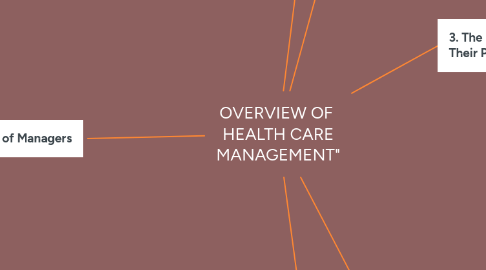
1. 6. Role of Managers
1.1. 1. Establishing and Maintaning Organizational Cultures
1.1.1. Organizational cultures
1.1.1.1. defined as character, personality and organizational life
1.1.2. Values
1.1.2.1. Principle of organization believes in and shape the organization's purpose, goals and day to day behavior
1.1.3. Mission
1.1.3.1. Organization fundamental purpose
1.1.4. Vision
1.1.4.1. Desires Future state for the organization
1.1.5. Establishing codes of conduct or Standard of Behavior
1.1.5.1. should align with values, mission and vision
1.2. 2. Talent Management (Human Resource Management)
1.2.1. Critical responsibilities of Managers
1.2.1.1. Promote Employee Engagement
1.2.1.1.1. described as motivation and commitment of staffs to contribute for the organization
1.2.1.1.2. Strategies to Sustain Empoloyee Engagement
1.2.2. Organization should view employees as strategic assets who can create competitive advantage.
1.2.3. Other than recruitment , managers should concerned about developing & retaining staffs with excellent performance.
1.3. 3. Ensuring High Performances
1.3.1. Organization should be result oriented with identified pillars of excellence as framework to organizations' goal
1.3.1.1. Pillars
1.3.1.1.1. People (employee, patients, physician)
1.3.1.1.2. Service
1.3.1.1.3. Quality
1.3.1.1.4. Finance
1.3.1.1.5. Growth
1.3.2. 5 Key Steps in Performance Management
1.3.2.1. 1. Set Objectives
1.3.2.2. 2. Measure Performances
1.3.2.3. 3. Compare Performances
1.3.2.4. 4. Determines Reason for Deviation
1.3.2.5. 5. Take Corrective Action
1.3.3. Common Method- Use of Balance Scorecards
1.3.3.1. Allow quick interpretation of organizational performance across numbers of key measures
1.4. Stakeholder Expectation (Goverment/ Insurers/ Consumers) from our services:
1.4.1. Safe
1.4.2. Low-cost
1.4.3. Convenient
1.4.4. High quality enviroment
1.5. 4. Leadership Development and Succession Planning
1.5.1. 1. Definitions
1.5.1.1. Leadership Development
1.5.1.1.1. Educational interventions and skill-building activities designated to improve leadership capabilities of individuals
1.5.1.2. Succesion Planning
1.5.1.2.1. Concepts of taking actions to ensure staffs can move up in management roles within organization to replace retires/ resign/move to other organization
1.5.2. 2. Senior Executive have a primary role in ensuring managers throughout organization to have knowledge & skills to provide effective leadership
1.5.2.1. Increase leadership skills & behaviors
1.5.2.2. Ensure stability within organization
1.5.3. 3. Key Roles
1.5.3.1. 3. Develop future leaders
1.5.3.1.1. Leadership Development Program
1.5.3.2. Engage in succession planning
1.5.3.2.1. 2 Methods
1.6. 5. Innovation and Change Management
1.6.1. 1. Innovations
1.6.1.1. 2 Types Managements
1.6.1.1.1. 1. Management Innovation
1.6.1.1.2. 2. Operational Management
1.6.1.2. Skills needed:
1.6.1.2.1. 1. Thinking Creatively
1.6.1.2.2. 2. Willingness to test innovative practices & assess their impact
1.6.1.2.3. 3. Facilitate Recruitment & Development whp embrace creativity & innovation
1.6.1.2.4. 4. Development & Use of Clinical Procedures & Practices
1.6.1.3. Barriers of Innovation
1.6.1.3.1. 1. Lack of innovation culture among staffs
1.6.1.3.2. 2. Lack of leadership in innovation efforts
1.6.1.3.3. 3. High cost to make innovative things
1.6.1.3.4. 4. Formal rules & regulation or policies go against innovation
1.6.1.3.5. 5. Daily priorities & inertia reflecting status quo
1.6.2. 2. Change Movement
1.6.2.1. Structured management approach to improving organization & its performance.
1.6.2.2. Managing organizational changes
1.6.2.2.1. is a key competency of health care managers
1.6.2.2.2. 4 Key Steps
1.7. 6. Health Care Policy
1.7.1. One of the critical areas for managing External Domain. Managers should be:
1.7.1.1. Knowledgeable about health policy matters under consideration at the state & federal levels that affect health services organization & health care delivery
1.7.1.2. Help to influence policy in positive ways that will help organization & limit adverse impact.
1.8. 7. Research in Health Care Management
1.8.1. Current research in management focuses on best practices
2. 1. Introduction
2.1. 1. Direct Care Setting
2.1.1. Organization that pprovide care directly to patient, resident or clients who seeks services from organization
2.2. 2. Non-direct Care Setting
2.2.1. Support the care of individuals through products & services made available to Direct Care setting.
3. 5. Management Positions: Organizational Heirachy
3.1. 1. Functional organizational structure
3.1.1. eg. Hospital Directorship
3.2. 2. Matrix model
3.2.1. Involvement of multi-unit to perform one task/ event/ programme
3.3. 3. Service Line Management
3.3.1. Head specific service line
3.3.2. eg. Gen Med, Surgery etc
4. 2. Health Care Management
4.1. Profession that provides leadership and directions to organizations that deliver personal health services and to divisions, departments, units, or services within those organizations.
5. 4. Management: Definition, Functions, Competency
5.1. 1. Definition
5.1.1. The process, comprised of social and techinical functions and activities, occuring within organizations for the purpose of accomplishing predetermines objectives through human and other resources
5.2. 2. 6 Management Functions
5.2.1. 1. Planning
5.2.2. 2. Organizing
5.2.3. 3. Staffing
5.2.4. 4. Controlling
5.2.5. 5. Directing
5.2.6. 6. Decision Making
5.3. 3. Competencies
5.3.1. 1. Conceptual Skills
5.3.1.1. Critically analyse & solve complex problems
5.3.2. 2. Technical Skills
5.3.2.1. Ability to perform specific task
5.3.3. 3. Interpersonal Skills
5.3.3.1. Ability to communicate with *& work well with other individuals
5.4. 4. Focus of Management
5.4.1. 1. Self
5.4.2. 2. Unit/ Department
5.4.3. 3. Organization
6. 3. The Need for Managers & Their Perspectives
6.1. Managers are needed to ensure:
6.1.1. Organizational tasks are carried out in the best way possible to achieve organizational goal
6.1.2. Appropriate resources, including financial & human resources, are adequate to support the organization
6.2. 2 Domains
6.2.1. 1. Internal Domain
6.2.1.1. Areas of focus managers need to address on daily basis
6.2.1.1.1. 1. Financial Performance
6.2.1.1.2. 2. Staffing
6.2.1.1.3. 3. Budgeting
6.2.1.1.4. 4. Quality Services
6.2.1.1.5. 5. Patient Satisfaction
6.2.1.1.6. 6. Physicians Relations
6.2.1.1.7. 7. Technology Acquisition
6.2.1.1.8. 8. New Service Development
6.2.2. 2 External Domain
6.2.2.1. Influences, resources, & activities outside boundary of organization but significantly affect the organization
6.2.2.1.1. 1. Community Demographic/ Need
6.2.2.1.2. 2. Licensure
6.2.2.1.3. 3. Accreditation
6.2.2.1.4. 4. Regulations
6.2.2.1.5. 5. Stakeholder Demands
6.2.2.1.6. 6. Competitors
6.2.2.1.7. 7. Medicare & Medicaid
6.2.2.1.8. 8. Managed Care Organization / Insurers