

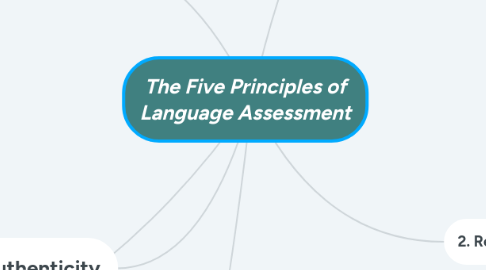
1. The effect of testing on teaching
2. 3. Validity
2.1. 4 Types
2.1.1. 1. Content- Related Evidence
2.1.1.1. Direct Setting
2.1.1.2. Indirect Setting
2.1.2. 2. Criterion-Related Evidence
2.1.2.1. Specific Classroom Objective
2.1.2.2. 2 Types
2.1.2.2.1. 1. Concurrent Validity
2.1.2.2.2. 2. Predictive Validity
2.1.3. 3. Construct-Related Evidence
2.1.3.1. Involves Theoretical construct
2.1.4. 4. Consequential Validity (Impact)
2.1.4.1. 1. Macro Level
2.1.4.1.1. the effect on society and educational systems
2.1.4.2. 2.Micro Level
2.1.4.2.1. the effect of on individual test-takers
2.1.5. 5. Face Validity
2.1.5.1. Psychological State of the learners
2.1.5.1.1. Confidence, Anxiety
3. 4. Authenticity
3.1. To stimulate real-world tasks
3.2. An authentic test
3.2.1. Natural language
3.2.2. Contextualized items than isolated
3.2.3. Meaningful, relevant, interesting topics
3.2.4. Thematic organization (story line or episodes)
3.2.5. the replicate of real-world tasks
4. 5. Washback
4.1. A test that provides beneficial Washback
4.1.1. Influences what and how teachers teach
4.1.2. Influences what and how learners learn
4.1.3. A chance to adequately prepare
4.1.4. Feedback that enhances language development
4.1.5. formative > summative
4.1.6. conditions for peak performers by learner
4.2. Effects
4.2.1. Positive
4.2.1.1. Teacher's Feedback: to diagnoses the strengths and weakness
4.2.1.2. intrinsic motivations, autonomy, self-confidence, language ego, interlanguage, and strategic investment
4.2.2. Negative
4.2.2.1. Standardized test
4.2.2.1.1. Simply gaining an acceptable score rather than improving language ability
5. 1. Practicality
5.1. Administrative Issues
5.1.1. Cost
5.1.2. Time
5.1.2.1. to conduct
5.1.2.2. to administer
5.1.3. Test-taker's test-wiseness
5.1.4. ease of scoring
5.1.5. ease of interpreting/reporting the result
5.2. Making, giving, and scoring an assessment instrument
6. 2. Reliability
6.1. Consistent & Dependable
6.2. The students
6.2.1. Anxiety, physical or physiological factors
6.3. The scoring
6.3.1. Rater reliability
6.3.1.1. Human error, subjectivity, bias
6.3.1.2. Inter-rater Reliability
6.3.1.2.1. Lack of scoring criteria
6.3.1.2.2. Inattention
6.3.1.2.3. Inexperience
6.3.1.2.4. Preconceived biases
6.3.1.3. Intra-rater Reliability
6.3.1.3.1. Unclear scoring criteria
6.3.1.3.2. Fatigue
6.3.1.3.3. Bias toward 'good' and 'bad' student
6.3.2. Measurement errors
6.3.2.1. Eg. items, distractors
6.4. Teachers can increase student's perception of fair tests
6.5. The test administration
6.5.1. Sounds
6.5.2. Chairs
6.5.3. Desks
6.5.4. Light