

1. Adult Learning Principles
1.1. Learning Outcomes
1.1.1. List at least 3 important adult learning principles.
1.1.2. Describe how to apply adult learning principles to improve the quality of training and learning of the participant.
2. COLLABORATORS
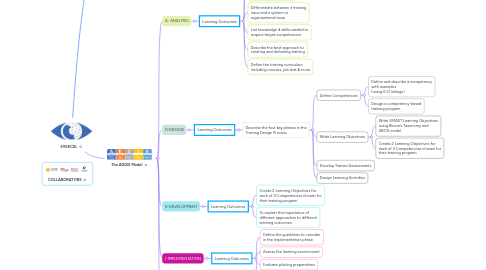
3. The ADDIE Model
3.1. A- ANALYSIS
3.1.1. Learning Outcomes
3.1.1.1. Define the target audience
3.1.1.2. Describe how to analyze training needs of the target audience
3.1.1.3. Differentiate between a training issue and a system or organizational issue
3.1.1.4. List knowledge & skills needed to acquire target competencies
3.1.1.5. Describe the best approach to creating and delivering training
3.1.1.6. Define the training curriculum including courses, job aids & more
3.2. D-DESIGN
3.2.1. Learning Outcomes
3.2.1.1. Describe the four key phases in the Training Design Process
3.2.1.1.1. Define Competencies
3.2.1.1.2. Write Learning Objectives
3.2.1.1.3. Develop Trainee Assessments
3.2.1.1.4. Design Learning Activities
3.3. D-DEVELOPMENT
3.3.1. Learning Outcomes
3.3.1.1. Create 2 Learning Objectives for each of 3 Competencies chosen for their training program
3.3.1.2. To explain the importance of different approaches to different learning outcomes
3.4. I-IMPLEMENTATION
3.4.1. Learning Outcomes
3.4.1.1. Define the guidelines to consider in the Implementation phase
3.4.1.2. Assess the learning environment
3.4.1.3. Evaluate piloting preparations
3.4.1.4. Identify stakeholders for training in the implementation phase.
3.5. E-EVALUATION
3.5.1. Learning Outcomes
3.5.1.1. Describe the process of evaluation using the Kirkpatrick model.
3.5.1.2. Explain when and how to conduct an evaluation to a training-related project.
3.5.1.3. Obtain hands-on practice on evaluating a training program over existing models